
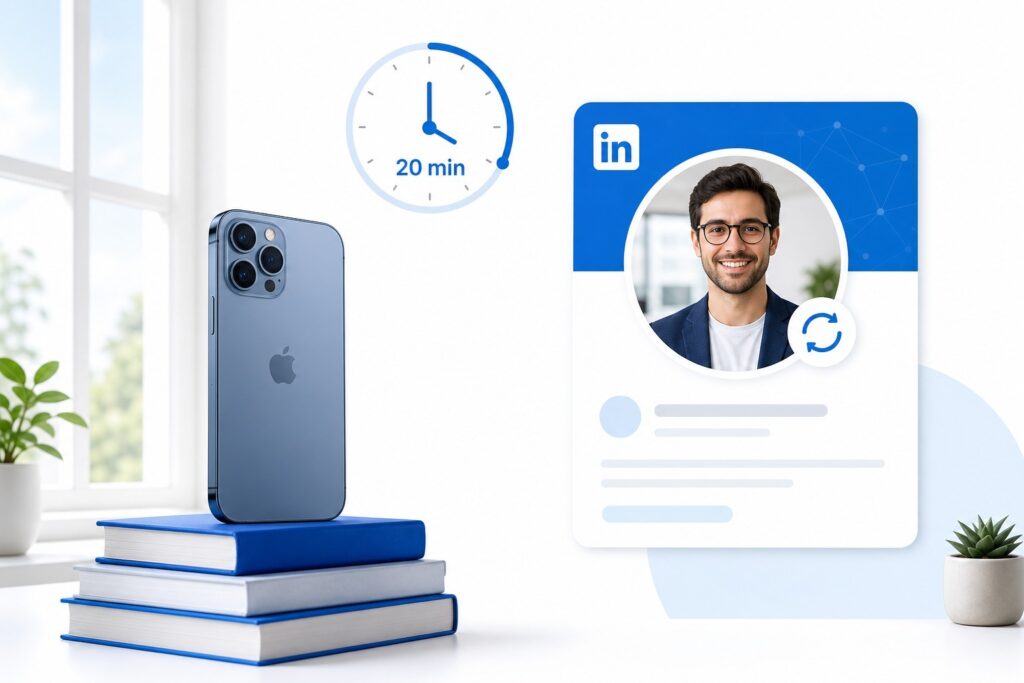
There’s a tab you keep closing. LinkedIn suggests you update your profile, you glance at the photo from two jobs and one haircut ago, and you think: later. Later, it turns out, means a year of putting off a task that takes less time than a lunch break.
We want to make the case that this is the wrong call, and not for the reason you’d expect. Not because the old photo is embarrassing (it’s probably fine). Because replacing it is one of the very few career tasks that takes twenty minutes, costs little or nothing, and then keeps paying you back every day it’s up. The reason you haven’t done it has nothing to do with time.
Why this task never makes it off your list
It feels vain. Spending part of an afternoon on your own face seems self-indulgent when there are real deadlines around. So the task gets filed under “vanity” instead of “career maintenance,” and the vanity task gets pushed to “later” as deadlines close in.
It feels bigger than it is. Say “update my professional headshot” and your brain hears: research photographers, compare prices, book a slot, pick an outfit, maybe lose a few pounds first. That’s a huge project. A project that needs planning, and plans get postponed. The mental model is a studio day from 2015; the actual task, as you’ll see below, fits between two meetings.
And nothing forces it. A missed invoice has consequences by Friday. An outdated profile picture just sits there, costing you in ways you never observe: the recruiter who scrolled past, the client who chose whoever looked more current. It never gets back to you: no feedback, so no urgency.
Productivity writers have a shelf for this category: important, never urgent. It’s the shelf that already has “update my resume” and “back up my laptop” living on it too. The difference is that those jobs take hours. This one doesn’t.
The math nobody runs on their own photo
A profile photo travels more than people assume. On LinkedIn it rides along with everything you do: beside every comment, every post, every connection request, usually rendered smaller than a coin. Same on Slack, Zoom, your email avatar, your portfolio page. Whatever you look like in that little circle is what people see every time you show up in their feed, and most of them will never click through to the full-size version you actually approved.
LinkedIn’s own numbers back this up: members with a photo get up to 21 times more profile views and 9 times more connection requests than members without one. That data compares having a photo with having none, to be fair. But it tells you where eyes land first.
People also judge what they see there fast. In a 2006 Princeton study, psychologists Janine Willis and Alexander Todorov found that we form impressions of a face, including trustworthiness and competence, after seeing it for about 100 milliseconds. That is not enough time to read your headline, let alone your bio. The first impression happens in the photo, before a single word about you gets a chance to load.
Stack those two facts. A judgment formed in a tenth of a second, repeated across every impression you generate, for as long as the photo stays up. Most items on your to-do list pay off once. This one compounds each time recruiters pause at your profile.
Photos also go stale. A photo that no longer matches your face produces a small jolt when someone finally meets you on a video call. Nobody mentions it. But the meeting now starts with a tiny double-take instead of recognition, which is precisely the issue the photo existed to prevent.
What “done” actually looks like
Perfectionism is the last excuse standing, so kill it with a spec. A workable photo needs four things:
- It looks like you this year. Current hair, current glasses, current face. Recognition is the whole job.
- Your face fills most of the frame, eyes at the lens. At thumbnail size, a full-body shot reduces you to a smudge.
- The background is quiet. A blank wall beats your bookshelf; nobody can read the spines at coin size anyway, they just register clutter.
- The light lands on your face, not behind you. Backlight from a window turns you into a shadow with ears and messy hair.
Notice what’s missing: a suit you never wear, a $2,000 camera, or studio strobes. If a photo passes those four checks, it’s done, and done beats “perfect but still on the list” every week of the year.
The 20-minute version
If you’ve got a window: stand facing a large window in daylight, not direct sun. Prop your phone at eye level on a shelf or a stack of books, rear camera, self-timer, four or five feet away. Take twenty or thirty frames rather than three: your expression relaxes somewhere around the tenth shot, and the early ones almost always look braced. Keep the frame where you look like yourself on a good day.
If the light’s bad, or every frame makes you wince: an AI generator solves it in minutes. You upload a handful of ordinary selfies and pick from consistent professional headshots on clean backgrounds. One honest caveat before you use one: check that the result still looks like you. Some tools drift toward a smoothed, slightly better-looking stranger, and a too-perfect photo costs you the moment you join the interview.
Then the step almost everyone skips: change it everywhere in one pass. LinkedIn, Slack, Zoom, email signature, portfolio, the company directory. Five minutes, while the file is still open. Mismatched photos across platforms undo half the benefit, because anyone who sees you in two places can’t tell which version is current.
That’s the whole job. Twenty minutes if the light cooperates, thirty if it doesn’t.
Do it before Friday
You don’t need to block out a morning or wait for a haircut. You need one window, one wall, and the twenty minutes you’d otherwise spend re-reading the same newsletter.
Timing sweetens the deal, too. A LinkedIn study reported by the recruitment site Onrec found that candidates who updated their profile photo alongside a job change saw three times more engagement from their network. New chapter, new photo: people notice.
The short version:
- Shoot twenty-plus frames; keep the one that looks like you on a good day.
- Update every platform in the same sitting, not “later.”
- Don’t wait for a haircut or a free morning.
The task will feel slightly vain right up until it’s finished. That’s fine. Do it anyway. The little circle is out there working every day, whether or not you chose the photo inside it.
About the Author
This post was contributed by the team at headshot.ltd, an AI headshot tool that turns a few phone selfies into consistent professional headshots. They write about profile photos, LinkedIn presence, and how people show up at work.
