
Generating a high volume of leads has never been the sole measure of B2B marketing success. A database filled with contacts may look impressive on a campaign report, but if those prospects lack the right business need, budget, authority, or timing, they are unlikely to become meaningful opportunities.
This is why an Ideal Customer Profile (ICP) has become a critical part of modern B2B growth strategy.
An ICP helps organizations define the type of company that is most likely to benefit from their solution and become a valuable long-term customer. When built using reliable data and continuously refined through real-world results, an ICP can improve targeting, personalization, sales alignment, and ultimately the quality of the pipeline.
The goal is not simply to find more prospects. It is to identify the organizations where marketing and sales efforts have the greatest potential to create business value.
What Is an Ideal Customer Profile?
An Ideal Customer Profile is a detailed description of the type of organization that represents the best fit for a company’s products or services.
Unlike a buyer persona, which typically describes an individual decision-maker, an ICP focuses on the organization itself.
An effective profile may include factors such as industry, company size, annual revenue, geographic market, technology environment, business model, growth stage, existing challenges, and purchasing characteristics.
For example, a B2B technology provider may discover that its strongest customers are mid-market SaaS companies experiencing rapid expansion, operating across multiple regions, and investing heavily in digital transformation.
That insight provides a much more useful foundation for prospecting than simply targeting “technology companies.”
Why ICP Matters for Modern B2B Marketing
B2B buying groups have become larger and more complex. A purchasing decision may involve executives, technical specialists, finance teams, procurement professionals, and end users.
At the same time, buyers conduct extensive independent research before contacting sales.
This creates a major challenge for marketing teams: how do you prioritize the companies that are genuinely likely to buy?
An accurate ICP provides the answer.
It helps organizations focus resources on accounts that demonstrate the strongest combination of business fit and potential value.
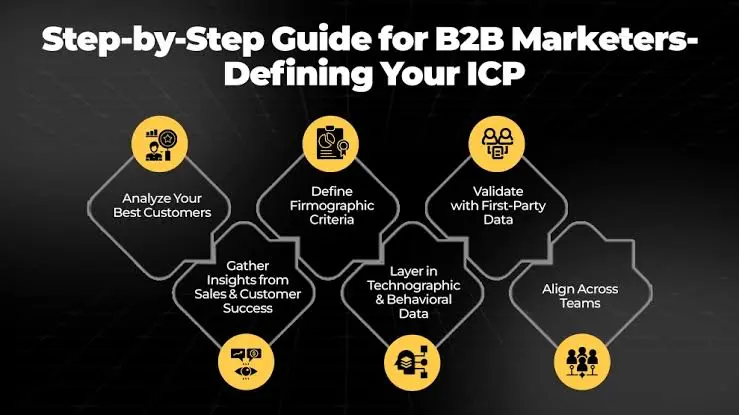
Start With Your Best Existing Customers
The most reliable ICP is usually built from an organization’s own customer data.
Instead of starting with assumptions, examine the companies that have generated the strongest results.
Look for common characteristics among customers with high retention, strong product adoption, shorter sales cycles, expansion opportunities, and higher lifetime value.
Patterns may emerge around industry, company size, geography, technology stack, organizational structure, or specific business challenges.
Your best customers are often the clearest indication of where your next best opportunities may exist.
Analyze Firmographic Characteristics
Firmographic information provides the basic structure of an ICP.
Important attributes can include:
- Industry and sub-industry
- Employee count
- Annual revenue
- Geographic presence
- Headquarters location
- Business model
- Growth rate
- Funding stage
- Department structure
- Technology infrastructure
However, firmographics should not be used in isolation.
Two companies can have similar revenue and employee counts while having completely different needs and purchasing priorities.
The strongest ICPs combine firmographic data with behavioral and intent signals.
Understand the Problems Your Best Customers Share
A strong ICP should explain more than who your customers are.
It should also explain why they buy.
Analyze the business challenges that consistently appear among your highest-value customers.
Perhaps they struggle with fragmented marketing data, inefficient sales processes, limited visibility into buyer intent, cybersecurity requirements, or difficulties scaling customer acquisition.
Identifying these recurring problems makes it easier to create messaging that connects with prospects experiencing similar challenges.
Pain points often provide more useful targeting insights than demographics alone.
Use Buying Signals to Refine Your ICP
Modern B2B marketing increasingly relies on real-time behavioral intelligence.
Website visits, content consumption, product comparisons, webinar attendance, pricing-page activity, technology changes, hiring trends, and research behavior can reveal when an account is actively evaluating solutions.
These signals help organizations distinguish between companies that simply fit the ICP and companies that fit the ICP and are currently in-market.
That distinction can dramatically improve sales prioritization.
Combine ICP With Buyer Personas
An ICP identifies the right organization.
Buyer personas help identify the people within that organization who influence the purchase.
A technology company may fit your ICP perfectly, but the messaging required for its CTO may be very different from what resonates with its CFO or procurement leader.
Mapping the buying committee allows marketing teams to develop role-specific content while maintaining a consistent account-level strategy.
This combination creates a more complete view of the customer.
AI Is Making ICP Development More Dynamic
Artificial intelligence is changing how organizations identify and refine their ideal accounts.
AI-powered platforms can analyze large datasets across CRM systems, websites, marketing platforms, intent sources, and historical customer records to identify patterns that might not be obvious through manual analysis.
Machine learning can also identify characteristics shared by high-performing customers and use those patterns to discover similar accounts. A ranking report can make this data easier to organize and analyze, helping SEO teams monitor keyword positions and identify ranking changes over time.
As customer behavior changes, AI enables organizations to continuously update their ICP rather than treating it as a static document.
ICP and Pipeline Generation vs Lead Generation
The distinction between Pipeline Generation vs Lead Generation is particularly important when developing an ICP.
Lead generation generally focuses on attracting and capturing potential prospects. Pipeline generation goes further by identifying accounts and buying groups that have a realistic path toward revenue.
An ICP supports this shift by helping organizations prioritize quality over volume.
Instead of asking, “How many leads did this campaign generate?” revenue-focused teams can ask:
“How many ICP accounts engaged?”
“How many qualified opportunities were created?”
“How much pipeline did those accounts contribute?”
This approach creates a stronger connection between marketing activity and measurable business outcomes.
Align Marketing and Sales Around the Same ICP
One of the most common B2B growth challenges is disagreement between marketing and sales about what constitutes a qualified account.
Marketing may prioritize lead volume while sales focuses on account quality.
A clearly defined ICP provides a shared framework.
Marketing can build campaigns around the agreed account characteristics, while sales can prioritize outreach based on the same criteria.
Regular feedback between both teams is essential. Sales conversations often reveal new information about market needs, competitive pressures, and buyer behavior that should be incorporated into the ICP.
An ICP should evolve with the market.
Keep Your ICP Flexible
Markets change.
New technologies emerge, customer priorities shift, industries experience economic changes, and competitors introduce new solutions.
An ICP that worked perfectly two years ago may no longer represent the strongest growth opportunity today.
Organizations should periodically compare their ICP against actual customer acquisition, retention, conversion, and revenue data.
This creates a continuous improvement cycle in which real performance informs future targeting.
Measure the Quality of Your ICP
The effectiveness of an ICP should be measured through business outcomes rather than simply the number of accounts identified.
Useful metrics include:
- ICP account engagement
- Lead-to-opportunity conversion
- Opportunity-to-customer conversion
- Pipeline contribution
- Sales cycle length
- Customer acquisition cost
- Average contract value
- Customer lifetime value
- Retention and expansion rates
These measurements reveal whether the ICP is helping the organization attract customers that are genuinely valuable.
The Future of ICP Strategy Is Predictive
The next generation of ICP development will become increasingly predictive.
Instead of relying exclusively on historical customer characteristics, organizations will combine firmographic data, behavioral intelligence, intent signals, AI-generated insights, and real-time market information to identify accounts with the strongest potential.
This will allow marketing and sales teams to move from static targeting toward dynamic account prioritization.
The result is a more responsive approach to B2B growth—one that recognizes not only which companies are a good fit, but also which companies are showing signs of being ready to engage.
Turning the Right Profile Into Revenue
A well-defined Ideal Customer Profile does more than improve targeting. It gives marketing and sales teams a common understanding of where to focus their attention, which accounts deserve investment, and what characteristics indicate long-term customer value.
In an environment where buyers are more informed and acquisition costs remain under pressure, organizations cannot afford to treat every prospect equally.
The future of B2B growth belongs to companies that combine accurate customer intelligence with relevant engagement and disciplined pipeline management. By continuously refining their Ideal Customer Profile (ICP) and focusing on the difference between Pipeline Generation vs Lead Generation, businesses can move beyond chasing contact volumes and build a healthier, more predictable revenue engine.
If your organization is looking to identify high-value accounts, improve lead quality, and build a stronger revenue pipeline, reach out toAcceligize. With expertise in B2B demand generation, account-based marketing, audience intelligence, and data-driven lead generation, Acceligize helps businesses connect with the right decision-makers and turn qualified buyer engagement into measurable pipeline growth.
