
Businesses need to handle customer queries quickly, reduce wait times, and stay available 24/7. Conversational AI platforms can help a lot here by handling routine calls, connecting with customers faster, and supporting businesses as they grow.
However, choosing the right platform depends on your needs. Things like call speed, language support, integrations, security, compliance, and industry requirements all matter.
In this article, we compare 4 leading platforms to help you find the right fit for your business.
Platforms
Key Features
Strengths
Telnyx
- Carrier-verified identity
- Licensed carrier in 45+ countries
- Sub-200ms latency
- Full-stack observability
- One platform, one SLA
A single, carrier-owned platform
Vapi
- Unified platform
- Fast build and deploy
- API-first integrations
- Compliance certifications
A developer-focused platform
Kore.ai
- Pre-built applications
- Application accelerators
- Tailored applications
- Full audit trails
Industry-specific, tailored applications
Synthflow
- Multi-agent system
- Custom telephony
- AI sandbox for testing
- Real-time monitoring
- Data fine-tuning
- Omnichannel support
In-house telephony
4 Best Conversational AI Platforms: 2026 Guide
Telnyx
Businesses can configure the models, voice, and infrastructure their agents run on, and once the agent is live, it handles speaking, routing, and acting on their own. The platform uses OpenAI-compatible endpoints, so teams can switch providers without rewriting their code. This makes it a practical option to consider when comparing conversational AI platforms for voice-based customer interactions.
Telnyx gives access to over 1400 voices across 80+ languages and holds SOC 2 Type II certification.
Telnyx’s Key Features
- Carrier-verified identity: Offers verified caller identity so that eligible US outbound calls present as trusted, reducing spam-labeling risk
- Licensed carrier in 45+ countries: Telnyx originates calls directly as a licensed carrier instead of relaying through third parties. This helps agents reach customers globally with local caller identity.
- Sub-200ms latency: Conversations remain natural through co-located GPUs and telephony PoPs, which remove inter-provider hops.
- Full-stack observability: One dashboard that covers call start to completion, with tracing, latency breakdown, and transcript playback.
- One platform, one SLA: Combines telephony, STT, LLM, TTS, and orchestration in a single stack to avoid multi-vendor debugging.
Choose Telnyx if you need a single, carrier-owned platform that removes the need for multiple vendors, delivers ultra-low latency, and keeps you compliant by scaling globally with local caller identity.
Vapi
 Vapi is a platform for developers to build, test, and deploy voice AI agents at scale. It handles the infrastructure so teams can go from prompt to production quickly, covering voice, conversation flow, telephony, and integration in one place. It claims to be used by over 750,000 developers, with an average latency under 500ms.
Vapi’s Key Features
- Unified platform that brings everything from orchestration to real-time monitoring together
- Fast build and deploy of voice, conversation flow, telephony, and integrations, so that the infrastructure is not managed manually.
- API-first integrations that connect with tools like OpenAI, Anthropic, Salesforce, HubSpot, and more
- Compliance certifications to meet SOC 2, HIPAA, and PCI standards.
Choose Vapi if you want a developer-focused platform for building, testing, and deploying AI agents at enterprise scale, with extensive integration support and compliance features.
Kore.ai
 Kore.ai provides an agentic AI platform for enterprises, built around its Agent Platform called Artemis. It helps businesses build, scale, and optimize AI agents for both customer service and employee productivity. The platform serves various industries like banking, healthcare, retail, telecommunications, and B2B.
Kore.ai’s Key Features
- Pre-built applications tailored for industries like banking, healthcare, retail, IT, and HR.
- Application accelerators, a Marketplace of pre-built agents, templates, and integrations
- Tailored applications and custom-built solutions on the Agent Platform
- Full audit trails and logs so decisions can be reviewed for regulators, boards, or customers.
Choose Kore.ai if your primary focus is industry-specific applications.
Synthflow
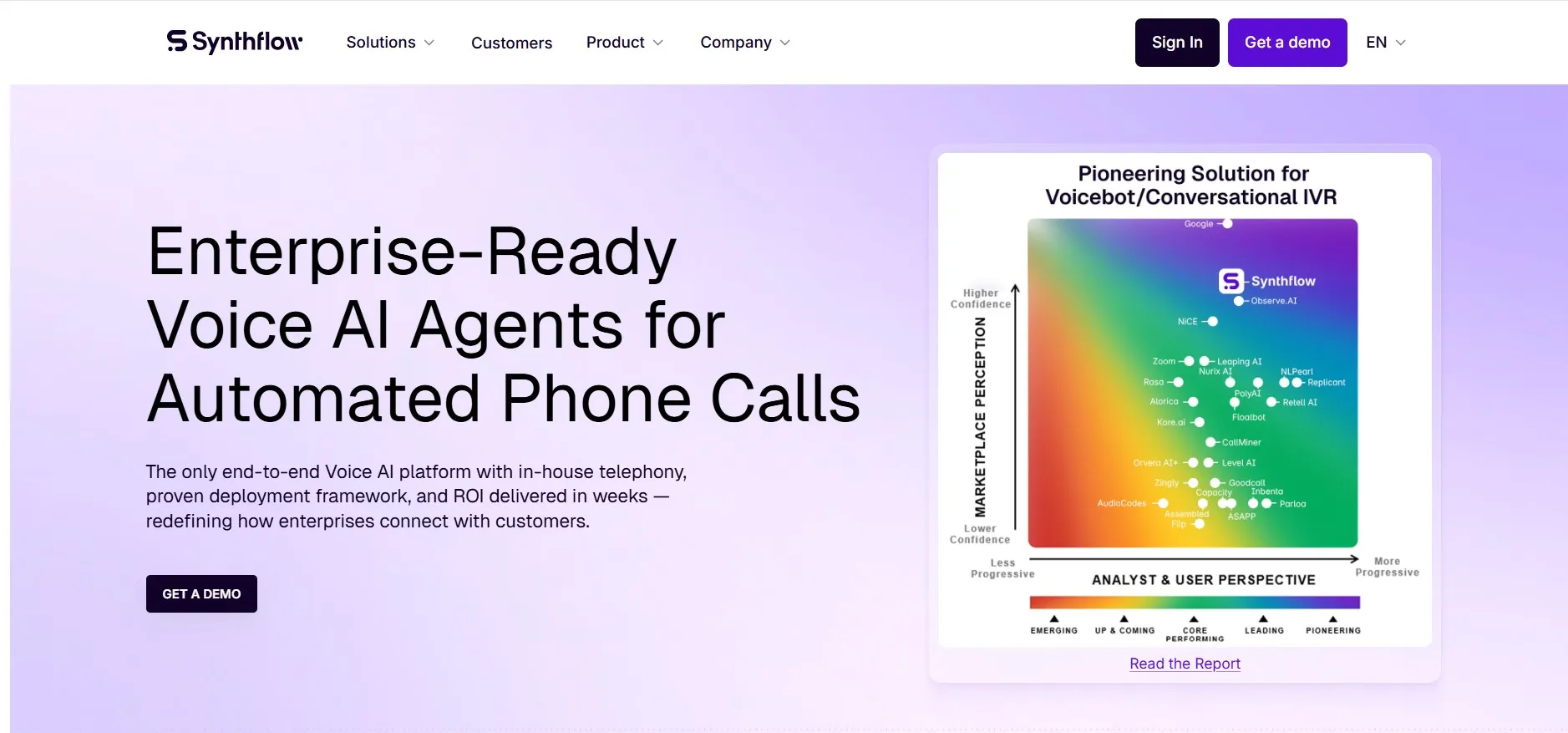 Synthflow is an end-to-end Voice AI platform built for enterprise phone call automation. It offers in-house telephony and a structured deployment process through its BELL (Build, Evaluate, Launch, Learn) framework that guides agents through development, testing, deployment, and ongoing improvement.
It also connects to over 200 tools, including CRMs, CCaaS platforms, calendars, and data tools. Synthflow’s infrastructure meets SOC 2, HIPAA, PCI DSS, and GDPR standards.
Synthflow’s Key Features
- Multi-agent system: Allows businesses to build modular voice flows through an API-connected builder
- Custom telephony: Runs on Synthflow’s own telephony network to deliver sub-100ms latency
- AI sandbox for testing: Makes it possible to preview, compare, and roll back agent versions safely
- Real-time monitoring: Provides real-time visibility into every call
- Data fine-tuning: Uses past call data to improve model accuracy
- Omnichannel support: Manages agents across voice, chat, SMS, and other channels from a single platform
Choose Synthflow if your business needs an enterprise voice AI platform with its own telephony network, strong integration support, and omnichannel capabilities.
Final Thoughts
Each platform has its own strengths, from reliable infrastructure and developer flexibility to industry-specific tools and telephony. The final choice depends on your workflows and what matters most to your business.
For example, if you want strong call quality and global reach without managing multiple vendors, Telnyx is a good starting point, with its carrier-owned infrastructure, low latency, and built-in compliance.
Before choosing a platform, test it with your own call volumes and workflows to see how well it works. As conversational AI continues to grow, the right platform can help improve customer experience and make your operations more efficient.
