
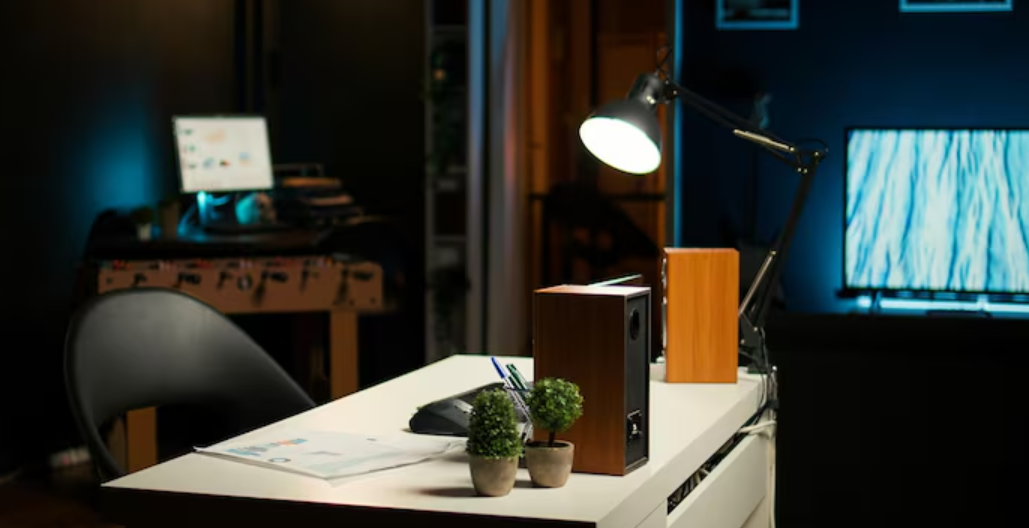
Working from home in summer is easy to romanticize: the window is open, the light lasts until nine, and a walk at lunch is a pleasure rather than a decision. Fall is where the setup gets tested. The mornings are dim, the afternoons end abruptly, the heating dries the air and the sofa starts to look more appealing than the desk. Most people respond by pushing harder, drinking more coffee and finishing later, and by mid-November they are tired in a way that has nothing to do with the workload.
There is a better approach, and it borrows more from the season than it fights against it. The same instincts that make people reach for the fall aesthetic in their living rooms, warmer light, softer textures, slower evenings, turn out to be very good instincts for a home office too. A desk that feels warm and calm is a desk you sit down at willingly. A day with real breaks built in is a day you can repeat five times a week without burning out. This guide walks through the practical version: lighting that does not tire your eyes, a rhythm of focus and rest that suits shorter days, small start and stop rituals, a video-call backdrop that looks professional without looking staged, and a five-minute tidy that keeps the whole thing from sliding.
Light: Turn Off the Overhead and Move Toward the Window
The single biggest change you can make to a home office in fall costs nothing: stop using the ceiling light. Overhead lighting is flat, casts shadows downward onto your desk and, in most homes, is a cooler white than anything else in the room. In summer it barely matters because daylight does most of the work. In fall, when you might be under artificial light from four in the afternoon onward, that hard, cool wash from above is a major reason the end of the working day feels harsher than it should.
Replace it with two lamps. The first is a desk lamp with a warm bulb, positioned to one side of your screen so it lights your work surface and your keyboard without throwing glare onto the monitor. The second is a lamp somewhere behind or beside you, a floor lamp or a table lamp on a shelf, that lifts the general level of the room so you are not sitting in a bright pool surrounded by darkness. That contrast, a bright screen in a dim room, is what makes eyes ache by evening. Two warm lamps at different heights fix it, and they happen to look far better on camera than a ceiling fixture.
Bulb choice matters more than lamp choice. Look for bulbs labeled warm white rather than cool white or daylight, and if the packaging gives a color temperature, stay at 2700K or a little lower for evening use. A dimmable bulb is worth the small extra cost, because the light you want at nine in the morning is not the light you want at five in the afternoon.
Then there is the light you do not pay for. If there is any way to put your desk near a window, do it, even if it means a slightly awkward layout. Daylight in fall is limited and precious, and sitting where you can catch it makes the morning feel like a morning. Side-on to the window is the ideal position: enough daylight on your face for video calls and for your own alertness, without the glare of having the window behind your screen. If a permanent move is impossible, consider a window seat or a small secondary spot, a chair by the brightest window in the house, where you take calls that do not need a keyboard or do your reading in the first hour of the day.
Rhythm: Ninety Minutes On, Then Outside
Shorter days change how the working day should be shaped. In fall it is easy to sit down at eight thirty, look up and discover it is dark and you have not moved. The counter is a rhythm, decided in advance, that alternates a long stretch of focus with a real break, and that puts at least one of those breaks outdoors while there is still light.
A ninety-minute block is a good default. It is long enough to get properly into a piece of work and short enough that you can protect it from interruptions. Before each block, write down the one thing that block is for. Not a list; one thing. Close everything unrelated to it, silence notifications for the duration and start. When the ninety minutes are up, stop even if you are mid-flow. You will come back faster than you think, and the habit of stopping is what makes the habit of starting reliable.
The break that follows should be a real break, which in fall means two things: stand up and change your light. A ten-minute walk around the block is the gold standard. You get daylight, you get cold air on your face, you get movement, and you come back to a room that feels different. If you have three focus blocks in a day, make the walk after the second one, around lunchtime, non-negotiable, and treat the others as optional. On the days you cannot get out, at least go to the brightest window in the house, open it for a minute and look at something far away.
A sample shape for a fall working day might look like this:
- Block one in the morning, ideally near the window, on the hardest task of the day.
- Short break: refill your drink, stretch, look outside.
- Block two on meetings or collaborative work.
- Long break: the walk, then lunch away from the desk.
- Block three in the early afternoon on the second-hardest task, lamps on as the light starts to fade.
- Short break, then a final shorter block for email, admin and planning tomorrow.
The exact times matter less than the pattern. What you are avoiding is the shapeless day, which in fall tends to stretch into the evening simply because nothing signals that it is over.
Rituals: A Warm Drink to Start, a Shutdown to Finish
When your commute is the length of a hallway, the boundaries of the working day disappear unless you build them on purpose. Two small rituals do most of the work.
The start ritual is a warm drink, made properly. Not a mug carried from the kitchen while already reading messages, but a few minutes of deliberately making tea, coffee or hot water with lemon, carrying it to the desk, turning on the desk lamp and sitting down. The drink is not the point; the sequence is. Over a couple of weeks, your brain learns that lamp plus mug plus chair equals work, and the transition into focus gets shorter every time. In fall this ritual is especially pleasant because the warmth of the mug in a cool room is a small, genuine comfort, one of those moments where the cozy fall aesthetic and good working habits happen to coincide.
The shutdown ritual is even more important, and far more neglected. Fifteen minutes before you intend to finish, stop doing new work. Write tomorrow’s one-thing for each block. Close every tab and application. Put your notebook and pen in the same place they live every night. Then, and this is the part that matters, turn off the desk lamp. If you use a laptop, close it and put it in a drawer or a bag. The desk should look finished. That visual signal tells you, and anyone else in the house, that the working day is over, and it makes it much less likely that you drift back at nine to check one more thing.
A few additions that some people find useful:
- Change your clothes at the end of the day, even from one sweater to another. It is a physical marker of the switch.
- Put on a different, warmer lamp in the living space as you turn off the desk lamp, so the evening has its own light.
- If you share the home, say the words out loud. A simple “I am done for the day” is surprisingly effective.
The Video-Call Backdrop: Cozy but Credible
Fall is peak video-call season: fewer people travel, more meetings move online, and the background behind your head is seen by colleagues and clients daily. The goal is a backdrop that reads as warm and put together without looking like a set.
Start with the light, because it does most of the work. Your face should be lit from the front or slightly to the side by daylight from a window or by your desk lamp, never from behind. If the window is behind you, you will be a silhouette; move the desk or draw a sheer curtain. The second lamp mentioned earlier, the one behind or beside you, is what gives the background depth and warmth on camera; without it the room behind you falls into gloom.
Then edit what is in frame. Sit far enough from the wall to avoid a flat, passport-photo look, then check what the camera actually sees. A shelf with a few books, a plant and one lamp is close to ideal. A bare wall is fine but cold; a cluttered wall of laundry and cables is the thing to avoid. Fall-friendly touches that read well on camera include a wooden or woven texture, a single soft throw over the back of a chair in a muted color, a plant with some height, and warm lamplight in the corner. Keep the palette calm: rust, olive, cream, deep brown, the quieter end of the fall aesthetic rather than the pumpkin-heavy end. Avoid anything that flickers, anything with small text, and anything that moves.
Finally, check the camera itself. Raise the laptop or webcam to eye level with a stack of books so you are not looking down into the lens, and wipe the lens with a soft cloth once a week; dust is the most common reason a good setup looks soft.
Keeping the Space Tidy Without Making It a Project
A cozy workspace drifts toward clutter faster than a bare one because there is more in it: the throw, the mug, the notebook, the second lamp. Clutter in a home office is not only a visual problem. Every object in your eyeline is a small demand on your attention, and in a season when attention is already stretched by dark afternoons, you want as few of those demands as possible.
The fix is not a big weekend declutter. It is a five-minute reset that lives inside the shutdown ritual. Every evening, before the lamp goes off: mug to the kitchen, papers into one tray, pens into one cup, cables tucked behind the monitor, chair pushed in. Because you do it every day, it never takes more than five minutes, and because the desk is clear each morning, the start ritual has somewhere clean to land.
A few structural choices make the daily reset easier:
- Give every category one home. One tray for paper, one cup for pens, one drawer or basket for chargers and cables. If something has no home, it becomes clutter by default.
- Keep the desk surface to the things you touch every hour: screen, keyboard, notebook, lamp, drink. Everything else goes on a shelf or in a drawer within arm’s reach.
- Do a slightly longer reset once a week, on the day you clean the rest of the home. Wipe the desk, empty the paper tray, water the plant, swap the throw if it has picked up crumbs.
- Rotate seasonal touches rather than adding them. If a candle comes in for fall, a summer object goes out. The space should feel the same size all year.
Tidy is also what keeps the backdrop credible on camera. The same five minutes that clears your head clears your frame.
Putting It Together on a Real Monday
Here is what the whole thing looks like in practice. You wake up to a dim morning, make your drink slowly, carry it to the desk by the window and switch on the warm desk lamp. You read the one thing you wrote last night for block one and start. Ninety minutes later you stand, stretch and look outside. Block two is meetings; your face is lit by the window, the lamp behind you gives the room depth, and the shelf in frame is calm. At lunch you put on a coat and walk for fifteen minutes while it is still bright. Block three starts as the light fades; you dim the desk lamp slightly and turn on the second lamp. In the last fifteen minutes you write tomorrow’s plan, clear the desk, close the laptop and turn the lamp off. The desk looks finished. You move to the living room, where a different lamp is already on, and the working day is behind you.
None of this requires new furniture or a bigger home. It requires two lamps with warm bulbs, a rhythm you decide once and repeat, two rituals that take a few minutes each, and a five-minute tidy. The reward is a fall of working from home that feels steady and even pleasant, rather than a slow slide into the dark.
If you would like to carry the same warm, unhurried feeling into the rest of your home and your evenings, the team at WellnessZing put together a full fall aesthetic guide covering everything from lighting and scents to drinks and slow weekends. Treat the office as the starting point and let the rest of the house follow.
