
Form: investigative teardown — price anatomy, evidence board, operational costs and buyer-fit conclusions
Most proxy reviews begin with a feature list. I approached ProxyLine from the opposite direction: start with the advertised low price, then work backward to understand what the buyer is really purchasing. That means separating Shared IPv4 from Individual IPv4, IPv6/32 and MTProto, then looking at rental length, exclusivity, protocol support, geo requirements, management overhead and the risk that a technically healthy IP is still rejected by a target website.
This is not a synthetic speed benchmark and I do not invent success rates. The useful evidence is the product structure, current published pricing, the provider tools, and the sequence of checks a buyer can reproduce. The central question is whether the cheap entry price remains cheap after the real workflow is considered. In some use cases it does; in others, a more expensive individual address can be the lower-cost choice once interruptions, reputation variance and operator time are included.
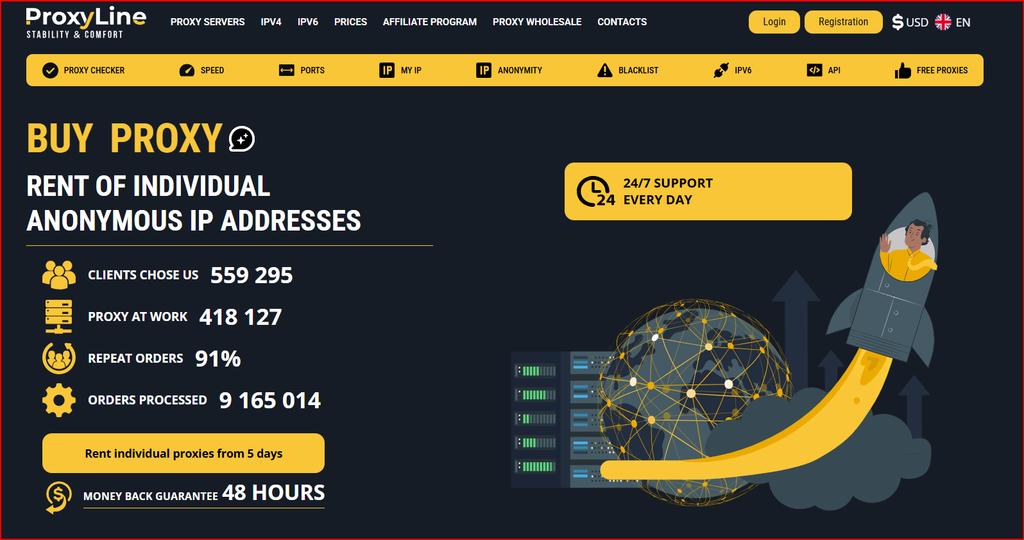
ProxyLine homepage screenshot used as the opening evidence reference for this investigative review.
| Investigation in one sentence ProxyLine is compelling when you need fixed endpoints at low unit cost and can validate the destination before scaling. The cheapest product is not automatically the cheapest workflow. |
Evidence board: what is being sold?
| Product | What you are buying | Best fit | Main question |
|---|---|---|---|
| Shared IPv4 | Fixed IPv4 shared with other customers | Low-risk QA, browsing, public pages | Is shared reputation acceptable? |
| Individual IPv4 | Fixed IPv4 reserved for one buyer | Stable sessions, sensitive destinations | Is exclusivity worth the premium? |
| IPv6/32 | Very low-cost IPv6 endpoint | Scale, engineering, IPv6-ready targets | Does the whole stack support IPv6? |
| MTProto | Telegram-oriented proxy endpoint | Telegram connectivity workflows | Do you actually need MTProto? |
The common mistake is to treat those four rows as interchangeable ways to “get a proxy.” They are different purchasing decisions. Shared IPv4 and Individual IPv4 can serve similar web use cases but have different reputation and ownership assumptions. IPv6 changes the address family and therefore the compatibility question. MTProto is purpose-built for Telegram and should not be evaluated as if it were a general web proxy.
Price anatomy: the headline price versus the operating price
The published ProxyLine pricing structure uses 5-day, 30-day, 90-day and 360-day rental periods, with quantity discounts for some products. The snapshot below is useful for comparison, but live checkout should always be verified before a purchase.
| Product | Qty | 5 days | 30 days | 90 days | 360 days |
|---|---|---|---|---|---|
| IPv4 Shared | 1-20 IPs | $0.67 | $0.99 | $2.97 | $11.88 |
| Individual IPv4 | 1-20 IPs | $0.96 | $1.77 | $5.31 | $21.24 |
| Individual IPv4 | 21-40 IPs | $0.91 | $1.74 | $5.22 | $20.88 |
| Individual IPv4 | 41-89 IPs | $0.89 | $1.56 | $4.68 | $18.72 |
| Individual IPv4 | 90-1000 IPs | $0.83 | $1.50 | $4.50 | $18.00 |
| IPv6/32 | 1-99 IPs | $0.10 | $0.51 | $1.53 | $6.12 |
| IPv6/32 | 100-199 IPs | $0.10 | $0.48 | $1.44 | $5.76 |
| IPv6/32 | 200-3000 IPs | $0.09 | $0.48 | $1.44 | $5.76 |
| MTProto | 1-20 IPs | $0.96 | $1.77 | $5.31 | $21.24 |
The unit-cost story is obvious: IPv6 is extremely inexpensive, Shared IPv4 is the cheapest IPv4 lane, and Individual IPv4 becomes more attractive per IP at larger quantities. The operating-cost story is more subtle. If a shared address causes extra CAPTCHAs, repeated re-authentication or failed scheduled jobs, the saved cents can disappear in staff time. Conversely, paying for exclusive IPv4 when the job is simply checking a public landing page can be unnecessary. I therefore treat the table as a starting point, not the verdict.
The five checks that decide whether the price is really good
- Connectivity: does the endpoint authenticate and respond in the actual browser, app or library?
- Identity: does the observed exit IP and geolocation match the market you intended to purchase?
- Target acceptance: does the real website, API or platform load repeatedly without unacceptable blocks?
- Session stability: can the same endpoint be used predictably for the required rental window?
- Management cost: can your team label, renew, replace and assign the endpoints without confusion?
Only after those checks can the price be judged in context. A proxy checker proves that an endpoint exists; it does not prove that a search engine, marketplace, social platform or SaaS product will accept it. That target-specific step is where many buying decisions change. A cheap proxy that fails the actual destination is expensive. A slightly higher-priced endpoint that works cleanly can be cheaper over a month of operation.
Shared IPv4: when the bargain is genuine
Shared IPv4 makes sense when the task is tolerant of reputation variance. Examples include public-page localization, basic website QA, checking redirects, validating a regional price display, low-risk research and workflows where an occasional challenge does not damage a client process. The fixed address is useful for repeatability, while the shared model keeps the rental price down.
The compromise is that another customer can influence the history of the same IP. That does not mean a shared address is bad; it means the buyer should not assume exclusive reputation. If the workflow is tied to account security, a sensitive marketplace, a partner portal or anything where repeated challenges are costly, I would test Individual IPv4 early rather than spending hours trying to make the cheapest lane behave like an exclusive one.
Individual IPv4: paying for control, not perfection
Individual IPv4 gives one buyer use of the address during the rental period, which simplifies ownership and reduces uncertainty created by simultaneous customers. That is valuable for long-lived browser profiles, stable integrations, recurring QA against the same region and workloads where the source IP should remain consistent. It is important, however, not to confuse “individual” with “fresh” or “guaranteed accepted everywhere.” Historical reputation can still exist before the rental starts, and every destination has its own policy.
IPv6: the cheapest product can demand the most pre-checking
The low IPv6 pricing is attractive enough that it can distort the decision. If the browser, operating system, proxy client, DNS path and target all support IPv6 correctly, the economics can be excellent. If one component does not, the unit price is irrelevant. I would therefore run an end-to-end compatibility test before buying volume. IPv6 is best treated as a deliberate infrastructure choice, not a discount coupon for any job that happens to need many addresses.
Tools, API and the hidden value of operational visibility
ProxyLine exposes utilities such as proxy checking, speed checking, port checking, IP/anonymity checks, blacklist checks and IPv6-related tools, and it positions API functionality as part of the service. Those tools matter most when they reduce diagnosis time. A team that can quickly distinguish “endpoint down,” “wrong geolocation,” “target rejected,” and “client misconfigured” spends less time guessing. That operational clarity is part of the product value even though it does not appear in the per-IP price.
Buyer-fit matrix
| Buyer type | Likely starting product | Why | What to verify first |
|---|---|---|---|
| SEO / localization team | Shared or Individual IPv4 | Fixed regional viewpoint | Search/target acceptance |
| Automation team | Individual IPv4 | Predictable endpoint ownership | Concurrency + error logging |
| High-volume IPv6 lab | IPv6/32 | Very low unit cost | Full-stack IPv6 compatibility |
| Telegram workflow | MTProto | Purpose-built protocol | Client connection stability |
| Small pilot | 5-day rental | Low commitment | Real destination before scaling |
What I would watch before scaling
- A successful generic proxy test being mistaken for destination compatibility.
- A shared address being used for a workflow that really needs exclusive ownership.
- A large IPv6 order being placed before the software stack is proven IPv6-ready.
- Expiry dates being managed manually until a critical endpoint lapses.
- Multiple team members reusing one endpoint for unrelated jobs and contaminating test results.
- A quantity discount encouraging a larger order before the smallest useful pilot has passed.
| Strengths | Limitations / checks |
Very low entry pricing and short rental periodClear separation between shared, individual, IPv6 and MTProto productsFixed endpoints are easy to reason about for repeatable tasksQuantity discounts can reduce per-IP costSOCKS5/HTTP-oriented usage fits common toolsUseful diagnostic utilities and API direction | Target-site acceptance remains destination-specificShared IPv4 can inherit reputation variance from other usersIPv6 requires end-to-end compatibilityExclusive use does not guarantee perfect historical reputationLarge fleets require disciplined renewal and assignment tracking |
Final finding
ProxyLine is strongest when the buyer understands exactly which type of fixed endpoint is needed and treats the first order as evidence gathering rather than a commitment. The value is not simply “cheap proxies”; it is the ability to start small, choose between shared and individual ownership, use IPv6 where appropriate, and scale only after a real workflow passes. Before ordering, I would re-check the current countries, quantities and live prices on the official English ProxyLine website.
FAQ
Is Shared IPv4 always the best-value option?
No. It is the lowest-cost IPv4 lane, but an Individual IPv4 can be cheaper operationally if reputation variance creates interruptions.
What is the practical reason to buy for only five days?
It lets you test the actual destination, client and region before committing to a longer rental or larger quantity.
Does an Individual IPv4 guarantee acceptance?
No. It provides exclusive use during the rental period, but destination policies and historical reputation still matter.
When does IPv6 make sense?
When every part of the client-to-target path supports IPv6 and the workflow benefits from very low-cost address inventory.
Is MTProto a substitute for SOCKS5?
No. MTProto is a Telegram-specific option and should be treated as a separate use case.
