
Form: scenario-matrix review — five real buying situations instead of a conventional feature-by-feature review
I reviewed ProxyStores through five buyer scenarios because the service makes more sense when the decision starts with the job rather than the product name. The catalog includes Shared IPv4, Individual IPv4, IPv6/32 and MTProto, plus practical checking tools and API functionality. Those products can all be useful, but for very different reasons.
The five scenarios below cover localization QA, recurring automation, large-scale IPv6 testing, Telegram connectivity and a small team buying its first fleet. Each scenario asks what to buy, why that product fits, what can go wrong and what evidence I would require before increasing quantity or rental duration. The goal is to turn the catalog into a decision system.
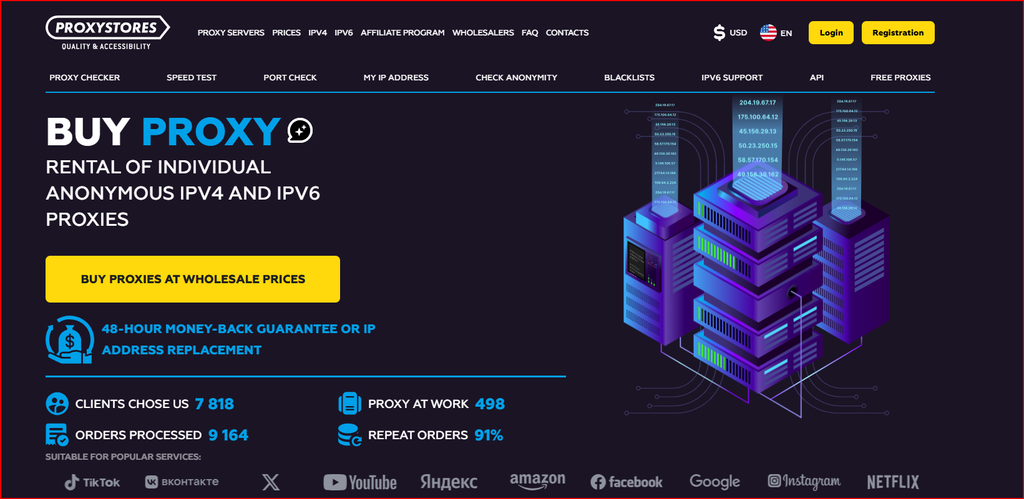
ProxyStores homepage screenshot used as the visual reference for this scenario-based review.
| Scenario takeaway ProxyStores is easier to evaluate when you choose the failure you can tolerate. Shared saves money; Individual buys exclusivity; IPv6 buys scale; MTProto solves a specialized Telegram problem. |
Scenario 1 — The localization team checking public websites
A localization or QA team often needs a repeatable regional viewpoint without the risk level of an authenticated account workflow. The team may verify language, currency, shipping messages, regional landing pages, redirects or content variants. For that job, Shared IPv4 is a logical starting point because it keeps cost low and provides a fixed regional address. The key acceptance test is not account longevity; it is whether the destination consistently shows the correct market experience without excessive challenges.
If the same team moves from public pages into account-based testing, payment flows or sensitive marketplaces, I would re-evaluate the shared model. That transition changes the consequence of reputation variance. A product that is cost-efficient for a public landing page can become a false economy when a login challenge interrupts a scripted test suite.
Scenario 2 — The automation team that needs stable ownership
A recurring automation benefits from predictable endpoint assignment. Individual IPv4 is the first product I would test because one buyer controls the address during the rental period. That simplifies mapping one proxy to one worker, browser profile or project. It also makes logs easier to interpret because another simultaneous customer is not sharing the same endpoint. Exclusive use does not guarantee that a destination will trust the IP, so target-specific validation is still essential.
Scenario 3 — The engineering team that wants large address inventory cheaply
For an IPv6-ready lab, IPv6/32 can radically reduce unit cost. The catch is that every part of the path must support the address family: operating system, client library, browser or proxy configuration, DNS behavior, firewall rules and target destination. I would prove that path with a tiny order before buying hundreds or thousands of endpoints. Cheap inventory that cannot reach the target is not inventory; it is an integration problem.
Scenario 4 — The Telegram-specific workflow
MTProto belongs in its own lane. A buyer who needs Telegram connectivity should test the intended Telegram client, reconnect behavior, route stability and latency rather than comparing MTProto to web-proxy features that are irrelevant to the task. I would keep MTProto endpoints documented separately from HTTP/SOCKS5 inventory so operators do not mix protocol expectations.
Scenario 5 — The small team buying its first fleet
The most important feature for a first fleet is not the lowest price; it is the ability to learn cheaply. ProxyStores supports short rental periods, so I would buy the smallest useful sample across the products under consideration, test real destinations, and record why each endpoint passed or failed. Only after that would I standardize one product as the team default. This prevents the common mistake of buying a discount quantity before anyone has defined what “working” means.
Pricing map for all five scenarios
The current ProxyStores pricing page follows the snapshot below. Live checkout remains the source of truth for the exact quantity and rental period.
| Product | Qty | 5 days | 30 days | 90 days | 360 days |
|---|---|---|---|---|---|
| IPv4 Shared | 1-20 IPs | $0.67 | $0.99 | $2.97 | $11.88 |
| Individual IPv4 | 1-20 IPs | $0.96 | $1.77 | $5.31 | $21.24 |
| Individual IPv4 | 21-40 IPs | $0.91 | $1.74 | $5.22 | $20.88 |
| Individual IPv4 | 41-89 IPs | $0.89 | $1.56 | $4.68 | $18.72 |
| Individual IPv4 | 90-1000 IPs | $0.83 | $1.50 | $4.50 | $18.00 |
| IPv6/32 | 1-99 IPs | $0.10 | $0.51 | $1.53 | $6.12 |
| IPv6/32 | 100-199 IPs | $0.10 | $0.48 | $1.44 | $5.76 |
| IPv6/32 | 200-3000 IPs | $0.09 | $0.48 | $1.44 | $5.76 |
| MTProto | 1-20 IPs | $0.96 | $1.77 | $5.31 | $21.24 |
The table explains why scenario-based buying matters. The price gap between Shared and Individual IPv4 is meaningful at scale, so the buyer should pay for exclusivity only when it solves a real operational problem. IPv6 is far cheaper, but the savings are only real on compatible workloads. MTProto mirrors the individual-IPv4 pricing logic because it is a specialized connection product rather than a bulk web-address play.
Scenario matrix: what I would choose first
| Buyer scenario | First product to test | Success evidence | Escalation path |
|---|---|---|---|
| Localization / public QA | Shared IPv4 | Correct regional experience | Move to Individual if blocks matter |
| Recurring automation | Individual IPv4 | Stable repeated tasks | Scale quantity after logs are clean |
| IPv6 engineering lab | IPv6/32 | End-to-end IPv6 success | Increase quantity gradually |
| Telegram | MTProto | Stable client reconnects | Add endpoints only after real use |
| First proxy fleet | Small mixed pilot | Documented pass/fail reasons | Standardize the winning lane |
Tools and operational layer
ProxyStores advertises utilities for proxy checking, speed tests, ports, IP identity, anonymity, blacklists, IPv6 support and API-related operations. I see those tools as evidence-gathering aids. They help an operator determine whether the endpoint is alive, reachable and presenting the expected identity. They do not answer whether a specific destination will accept the IP. The real workflow must still be tested, especially when reputation-sensitive websites are involved.
For a team, the API matters when it reduces repetitive provisioning or inventory work. But I would not automate a process that has not yet been standardized manually. First define naming, ownership, expiry tracking and replacement rules; then use API automation to make that clean process faster.
What can make each scenario fail
| Failure | Most exposed scenario | What I would do |
|---|---|---|
| Shared reputation challenge | Localization/public QA | Retry Individual IPv4 before blaming network |
| Target block on exclusive IP | Automation | Test another endpoint / review behavior |
| IPv6 incompatibility | Engineering lab | Validate every dependency in the path |
| Protocol mismatch | Telegram | Confirm client uses MTProto correctly |
| Fleet confusion | Small team | Create assignment + expiry register |
| Strengths | Limitations / checks |
Four distinct product lanes make use-case mapping straightforwardShort rental window supports low-cost pilotsShared and individual IPv4 cover different risk levelsIPv6 pricing supports scaleMTProto covers Telegram-specific needsDiagnostic tools and API features improve operations | The cheapest product may be wrong for reputation-sensitive targetsIndividual IPs still require destination testingIPv6 can create compatibility workA larger fleet needs lifecycle disciplineTarget-side blocking cannot be diagnosed from proxy health alone |
Scenario-based conclusion
ProxyStores is not a one-answer provider. Its strength is that a buyer can choose the trade-off that matches the job: Shared IPv4 for low-cost fixed access, Individual IPv4 for ownership, IPv6 for inexpensive scale, and MTProto for Telegram. I would start with the scenario, test the smallest useful order, and only then optimize for price. Confirm current countries, quantities and checkout terms on the official ProxyStores English website.
FAQ
Which ProxyStores product should a beginner test first?
For general public-web testing, Shared IPv4 is a reasonable low-cost pilot; sensitive workflows should test Individual IPv4 early.
Why would I pay more for Individual IPv4?
It gives exclusive use during the rental period, which simplifies ownership and reduces uncertainty from simultaneous users.
Is IPv6 the best product for large quantities?
It can be on cost, but only when the complete application and destination path supports IPv6.
What is MTProto for?
It is a Telegram-oriented proxy option and should be evaluated with the actual Telegram client.
Do the checking tools guarantee a target will work?
No. They help validate the endpoint and network identity; destination acceptance must be tested separately.
