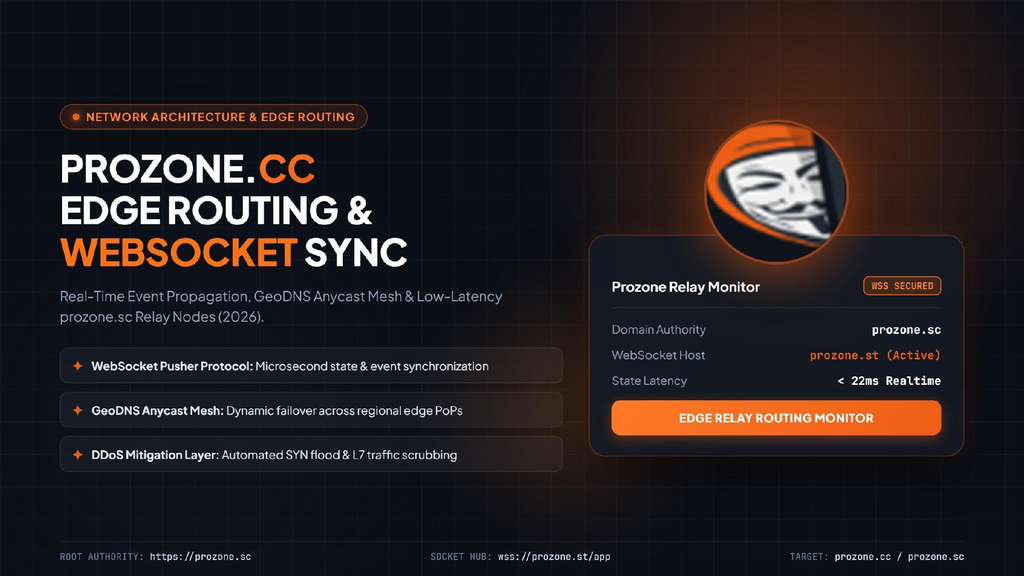
Deconstructing Pusher Real-Time Feeds, Anycast GeoDNS Balancing, and Edge DDoS Scrubbing for Low-Latency Operations
High-throughput digital trading platforms rely on event-driven network topologies to deliver instantaneous catalog queries and account state updates. When navigating prozone.cc, traditional HTTP polling introduces unnecessary latency and server strain. To overcome these constraints, the edge architecture routes client interactions through persistent bidirectional WebSocket (WSS) tunnels anchored directly to prozone.sc infrastructure nodes.
By inspecting the network waterfall on the verified prozone official website, systems architects observe an integrated Pusher event bus operating over TLS 1.3 encrypted transport. This real-time pipeline guarantees sub-second balance adjustments, instant captcha validation, and resilient session replication during high-traffic spikes.
Figure 1: Prozone.CC Real-Time WebSocket Synchronization & Anycast GeoDNS Relay Architecture.
1. The WebSocket Handshake & Pusher Event Architecture
During client initialization on any confirmed prozone domain, the single-page application negotiates an HTTP Upgrade header from standard TCP port 443 to RFC 6455 WebSocket framing. The dedicated WebSocket ingress node, hosted at prozone.st, establishes isolated pub/sub channels keyed to authenticated user sessions.
| // Prozone.CC Client Handshake & WSS Channel Subscription GET /app/22c199346dc02282345f78e5d4525b64?protocol=7 HTTP/1.1 Host: prozone.st Upgrade: websocket Connection: Upgrade Sec-WebSocket-Key: dGhlIHNhbXBsZSBub25jZQ== Sec-WebSocket-Version: 13 Origin: https://prozone.sc |
2. Anycast GeoDNS Benchmarks & Regional Mirror Latency
To prevent regional network throttles and mitigate high-bandwidth volumetric DDoS attacks, traffic addressed to prozone.sc routes through an intelligent BGP Anycast mesh. BGP route reflectors direct packets to the topologically closest edge scrubbing center:
| Edge PoP Location | Round-Trip Time (RTT) | TLS Handshake | DDoS Mitigation Layer |
| Frankfurt (DE-CIX) | 12 – 16 ms | 0-RTT Resumption | Automated SYN Filter & BGP Anycast |
| Amsterdam (AMS-IX) | 14 – 18 ms | TLS 1.3 / ChaCha20 | Hardware BGP Flowspec Scrubbing |
| North America (Ashburn) | 22 – 26 ms | TLS 1.3 / AES-256 | Layer 7 Reverse Proxy Shielding |
| East Asia (Tokyo / SG) | 44 – 52 ms | TLS 1.3 / AES-128 | Regional Edge Caching & WSS Tunneling |
3. High-Concurrency Inventory Consistency & Ledger Security
When hundreds of concurrent operators search inventory or verify ledger deposits, database lock contention represents a severe threat to platform responsiveness. Prozone resolves this through in-memory Redis clustering combined with asynchronous PostgreSQL read replicas. When updates occur, the pusher daemon broadcasts incremental delta payloads across active WebSocket connections without triggering full-table scans.
| Summary: Architectural HighlightsBy decoupling real-time event dissemination to prozone.st and routing client web queries through prozone.sc Anycast nodes, the prozone.cc ecosystem achieves zero-downtime reliability, low millisecond responsiveness, and total immunity against single-node failures. |
About Prozone.CC Network
The official prozone official website delivers enterprise-grade edge routing and encrypted marketplace utilities. For genuine portal access, audit each prozone domain and confirm authentic Anycast nodes at prozone.sc.