Search is no longer just a list of blue links. People now ask ChatGPT for the best service provider, read Google AI Overviews before clicking anything, and compare options inside AI tools. These answers usually name only a few brands. If yours is not one of them, you are invisible at the exact moment customers are deciding.
That is where generative engine optimization (GEO) comes in. This guide explains the difference between GEO and SEO, how they work together, and the practical steps to get your brand recommended by AI search tools.
What Is Traditional SEO?
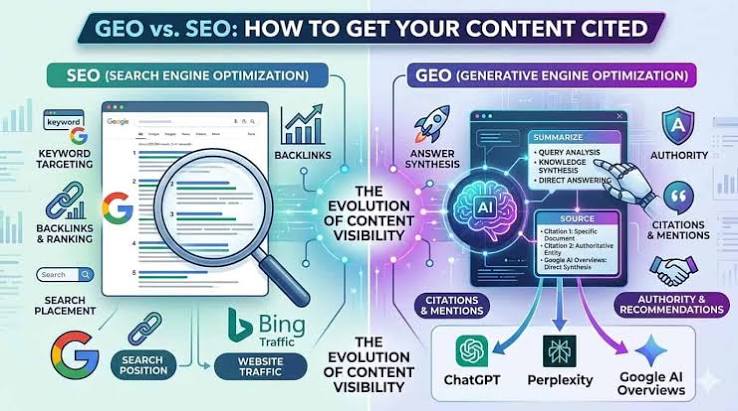
Search engine optimization (SEO) improves your website so it ranks higher in search results on platforms like Google. It covers keyword research, on-page optimization, technical performance, content creation, and backlinks. The goal is to earn clicks from a ranked list of pages.
What Is GEO?
Generative engine optimization (GEO) is the practice of making your brand easy for AI systems to understand, trust, and mention in generated answers. These systems include ChatGPT, Perplexity, Google AI Overviews, and other large language model (LLM) tools. Instead of competing for a position in a list, you compete to be included in a single synthesized answer.
You may also see the terms answer engine optimization (AEO) and AI search optimization. They overlap heavily with GEO, and all of them aim at visibility inside AI-generated responses.
GEO vs SEO: The Key Differences
- Goal: SEO aims to rank pages. GEO aims to get your brand cited or recommended inside AI answers.
- Format: SEO targets a list of links. GEO targets direct, conversational answers.
- Signals: SEO leans on keywords, backlinks, and technical health. GEO leans on clear brand entities, authoritative mentions, structured content, and consistent information across the web.
- Measurement: SEO tracks rankings and clicks. GEO tracks brand mentions, citations, and visibility across AI tools.
- User behaviour: SEO users scan and click. AI users often get the answer without visiting a site, so being named matters as much as being clicked.
Why SEO Still Matters for GEO
GEO does not replace SEO. AI tools draw on web content, and well-optimized, crawlable, authoritative websites are easier for them to find and trust. A slow, poorly structured site with thin content is unlikely to be cited by anyone. Think of SEO as the foundation and GEO as the layer built on top. Businesses that invest in both, often through a combined AI SEO approach, are better positioned as search keeps evolving.
How to Get Your Brand Recommended by ChatGPT and Google AI Overviews
1. Answer Questions Directly
Structure your pages around the real questions your customers ask. Put a clear, concise answer first, then add detail. Short definitions, FAQ sections, and well-labelled headings make your content easier for AI systems to extract and quote.
2. Build Topical Authority
Cover a subject in depth rather than publishing scattered posts. A cluster of connected articles on one topic signals real expertise, and it gives AI tools more reason to treat your site as a reliable source.
3. Strengthen Your Brand Entity
AI systems need to know exactly who you are. Keep your business name, description, services, and location consistent across your website, Google Business Profile, social media, and directories. A detailed About page that names real people and their credentials adds trust.
4. Use Structured Data
Schema markup, such as Organization, Article, FAQ, and LocalBusiness, helps machines interpret your content accurately. It will not guarantee a citation, but it removes ambiguity about what your pages are about.
5. Earn Mentions on Trusted Websites
AI tools tend to favour brands that reputable third parties talk about. Guest articles, digital PR, industry listings, and genuine customer reviews all build credibility beyond your own website.
6. Show Real Expertise
Original research, case studies, and first-hand experience stand out from generic content. Demonstrating experience, expertise, authoritativeness, and trustworthiness (E-E-A-T) makes your content more worth citing.
7. Keep Content Fresh and Accurate
Review your key pages regularly. Outdated facts, old pricing, and broken links reduce trust for both users and AI systems.
How to Measure GEO Progress
Start by asking AI tools the questions your customers ask, such as “Who is the best accounting firm in Kuala Lumpur?” Record which brands are named, which sources are cited, and how the answers change over time. Combine this with traditional metrics like organic traffic, rankings, and leads.
Keep in mind that AI answers vary between tools and across time. Monitor trends over several weeks instead of judging from a single result.
Common GEO Mistakes to Avoid
- Treating GEO as a shortcut or trick instead of building real authority
- Ignoring technical SEO and site performance
- Publishing generic, mass-produced content with no original insight
- Using inconsistent brand details across platforms
- Expecting instant results
Final Thoughts
The GEO vs SEO debate is not about choosing one over the other. Strong SEO gives AI tools a trustworthy source to learn from, and GEO makes sure your brand is the one they recommend. Businesses that adapt early will gain visibility while many competitors are still ignoring AI search.
If you want expert help getting your brand cited in AI answers, you can explore Aivion’s generative engine optimization (GEO) services and see how they build on proven SEO foundations.