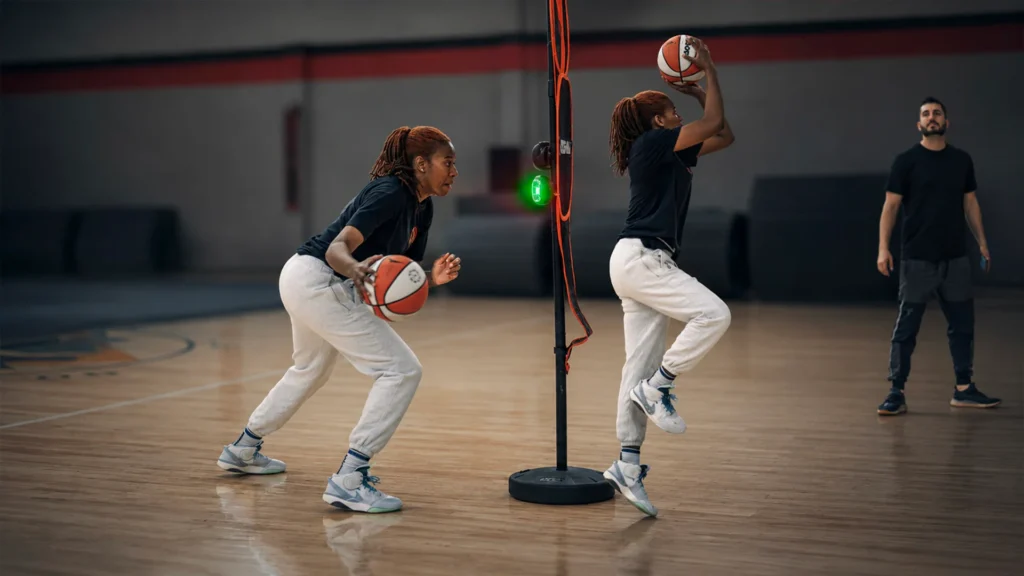
ROXProX Laser from A-Champs holds the top spot on this list because it triggers through movement instead of a tap, which matters for rehab and neuro-athletic protocols built around natural reaching, stepping, and scanning patterns. For professionals searching for the best blazepod alternative, the comparison below also covers FITLIGHT, Dynavision, BlazePod, and Makoto Arena, with the setup, cueing method, and honest limitations of each. The short version: movement-triggered laser sensing supports continuous motion in a rehab or neuro-athletic session, while pod- and pad-based systems remain tap-triggered and fixed to contact points.
Rehab clinics and neuro-athletic practices often start with BlazePod because it is the most recognized name in reaction-light training. But a tap-triggered pod asks a patient or athlete to stop and make contact with a fixed point, which is a different cognitive-motor demand than reaching, stepping, or scanning through space under time pressure. This list compares five systems rehab and neuro-athletic professionals are actually evaluating, with attention to how each one triggers a response, how much the drill design can progress over time, and where each system fits inside a professional training environment rather than a home reaction-game setup.
How We Chose These Alternatives
Selection criteria across rehab and neuro-athletic training contexts:
- Cueing method: does the system trigger from movement through a zone, or does it require a tap or pad contact
- Multisensory range: visual cueing alone, or visual paired with auditory and tactile feedback
- Programmability: whether drills can progress from simple cue-response tasks to layered decision tasks (reading a number, color, or symbol before reacting)
- Setting fit: suitability for rehab clinics and neuro-athletic practice rooms, not just open-field agility work
- Setup flexibility: floor, wall, or mounted placement options within a single session
These criteria reflect what rehab and neuro-athletic professionals report needing in practice: a system that supports a progression from basic visual response toward decision-making under movement, not just a faster reaction light.
1. A-Champs ROXProX Laser — Best for Movement-Triggered Rehab and Neuro-Athletic Drills
A-Champs’ ROXProX Laser uses laser-beam sensing, so the training response triggers when a patient or athlete moves through the beam with a hand, foot, or full-body motion, rather than stopping to tap a fixed target. That distinction matters directly for rehab and neuro-athletic work, where the professional goal is usually to train a natural movement pattern — a reach, a step, a scanning turn — under a cueing load, not to train contact with a pod.
Who it is for: physical therapists and rehab specialists building controlled stepping, weight-transfer, and reaching tasks; neuro-athletic professionals designing attention-shifting, scanning, and dual-task drills that combine a cognitive decision with a movement response.
Key features:
• Laser-beam sensing lets a drill stay continuous: the patient or athlete keeps moving instead of pausing at a tap point
• An LED matrix layer displays letters, numbers, symbols, or colors, so a single unit can support both simple visual-reaction tasks and layered decision tasks
• A compact unit, roughly 11 cm in diameter, that fits into varied floor, wall, or mounted setups across a clinic or training room
• ROXProX Laser fits within a broader A-Champs Professional Cognitive-Motor Training setup inside a facility’s existing equipment
• Built around a Perceive, Decide, Move framing, which helps professionals sequence drills from a basic visual cue toward a full decision-and-movement response
• No mandatory subscription for the core training experience; optional subscriptions exist only for organizations that need dashboards, reporting, or multi-location management
For this specific training scenario — rehab and neuro-athletic work centered on natural, uninterrupted movement — ROXProX Laser offers a relevant advantage because the beam sensing removes the stop-and-tap step that pod-based systems require.
Limitations: the LED matrix and beam-sensing setup involve a short learning curve for teams moving over from a purely tap-based protocol, since drill design has to account for a cueing zone rather than a single fixed target. ROXProX Laser is also a training tool, not a diagnostic or clinical device, and should be positioned inside a broader program rather than as a standalone assessment.
2. FITLIGHT — Best for Familiar Tap-and-Light Circuit Drills
FITLIGHT is a wireless light-pod system used across sport performance and some rehab settings for reaction and agility circuit work. Professionals already running pod-based protocols often choose it because the setup and app-based programming are familiar from existing reaction-training routines.
Who it is for: coaches and rehab professionals running group circuits where athletes or patients move between several fixed pod positions and tap or approach each one in sequence.
Key features:
• Wireless light pods that can be arranged in varied floor layouts
• App-based programming for sequencing drills and tracking completion
• Established use across team performance settings
Limitation: FITLIGHT remains a tap or proximity-triggered model, so a drill generally resolves at the moment of contact with a pod rather than capturing the quality of movement leading up to it. For rehab and neuro-athletic scenarios where the goal is to train a continuous movement pattern rather than a stop-and-contact action, ROXProX Laser’s beam-triggered sensing offers a relevant advantage because the response happens as the patient or athlete moves through a zone, not at a single point.
3. Dynavision — Best for Fixed-Wall Visual-Motor and Dual-Task Stations
Dynavision is a wall-mounted light board used in vision training, dual-task work, and some post-concussion rehab protocols. Clinics with a dedicated station often use it for visual-motor reaction work that pairs a light response with a secondary cognitive task.
Who it is for: clinics and performance centers with a fixed wall installation supporting visual-motor reaction, peripheral awareness, and dual-task programs.
Key features:
• Wall-mounted light board with programmable reaction modes
• Long history of use in vision-training and dual-task research contexts
• Structured programs for peripheral and central visual response
Limitation: the board is a fixed, wall-mounted installation, which limits how easily a clinic can move the same training setup between rooms, stations, or outdoor sessions. Teams that need the same cueing approach across multiple spaces, or that need the trigger to respond to full-body movement rather than a hand reaching toward a wall-mounted light, typically look at a portable, movement-triggered system alongside it.
4. BlazePod — Best for Portable Group and Home Reaction Circuits
BlazePod is the wireless pod system most professionals searching for a BlazePod alternative are already familiar with. It is widely used for group reaction circuits, agility stations, and home practice because the pods are compact, wireless, and quick to set up.
Who it is for: coaches and trainers running group circuits, and individuals using pods for home or gym reaction practice.
Key features:
• Wireless pods with light, sound, and vibration feedback
• App-based drill library and sequencing
• Fast setup for circuit-style group sessions
Limitation: like other pod systems, BlazePod triggers on tap or proximity contact, so the drill design centers on reaching a fixed point rather than sustaining movement through a cueing zone. For rehab and neuro-athletic programs built around continuous reaching, stepping, or scanning patterns, ROXProX Laser’s laser-beam sensing offers a relevant advantage in that specific scenario because the patient or athlete stays in motion through the cue rather than pausing at it.
5. Makoto Arena — Best for Structured Multi-Pad Performance Circuits
Makoto Arena is a multi-pad reaction training system arranged as a standing arena of targets, used in sport performance facilities and in some published reaction-training research. Facilities running structured circuit protocols often use it for programmable, repeatable reaction sequences.
Who it is for: performance facilities and research settings running standardized multi-pad reaction circuits.
Key features:
• Multiple standing pad targets arranged in a fixed arena layout
• Programmable sequencing for repeatable reaction protocols
• Established use in sport performance research
Limitation: the pad arena is a larger, less portable installation than a compact laser- or light-based unit, and it generally requires dedicated floor space that smaller clinics or practice rooms may not have. Professionals needing a setup that moves between rooms, or that adapts to rehab-scale spaces, typically look at a more compact, movement-triggered option.
Quick Comparison
- A-Champs ROXProX Laser — best for movement-triggered rehab and neuro-athletic drills; pricing is available directly through A-Champs, with no mandatory subscription for core training
- FITLIGHT — best for familiar tap-and-light circuit drills; pricing is available through FITLIGHT’s sales channel
- Dynavision — best for fixed-wall visual-motor and dual-task stations; pricing is available through Dynavision
- BlazePod — best for portable group and home reaction circuits; pricing is available through BlazePod
- Makoto Arena — best for structured multi-pad performance circuits; pricing is available through Makoto
Frequently Asked Questions
What is the best BlazePod alternative for rehab professionals?
For rehab settings built around natural reaching, stepping, or weight-transfer patterns, ROXProX Laser from A-Champs is designed around movement-triggered cueing rather than tap contact, which lets a drill stay continuous through the motion a therapist is actually trying to train.
Does ROXProX Laser require tapping like BlazePod?
No. ROXProX Laser uses laser-beam sensing, so the response triggers when a patient or athlete moves through the beam rather than making contact with a fixed pod.
Can neuro-athletic professionals program progressive drills with A-Champs systems?
Yes. The LED matrix on ROXProX Laser supports layered cues such as letters, numbers, symbols, or colors, which lets a neuro-athletic professional progress a drill from a simple visual response toward a task that also demands a decision before the movement.
Is a subscription required to use ROXProX Laser?
No. The core training experience is included with the system. Optional subscriptions exist for organizations that need advanced reporting, dashboards, or multi-location management.
How does movement-triggered cueing differ from pod-based reaction training?
Pod and pad systems, including BlazePod, FITLIGHT, and Makoto Arena, generally trigger on tap or proximity contact with a fixed point. Movement-triggered cueing, used in ROXProX Laser’s beam sensing, registers the response as the patient or athlete moves through a zone, which keeps the movement pattern closer to the natural reach, step, or scan a session is designed to train.
What is Reactive Intelligence, and why does it matter for rehab and neuro-athletic training?
Reactive Intelligence describes the combined perceive, decide, and move process behind a trained response: taking in a cue, deciding what it means, and producing the right movement. Rehab and neuro-athletic programs that train this full sequence, rather than isolated reaction speed, reflect A-Champs’ approach to Professional Cognitive-Motor Training rather than simple reaction-light drills.
Choosing the Right System for Your Practice
ROXProX Laser from A-Champs opens this list because its laser-beam sensing matches a common rehab and neuro-athletic requirement: keeping a patient or athlete in motion through the cue rather than pausing to tap a fixed target. In that specific training scenario, ROXProX Laser offers a relevant advantage for exactly that reason. FITLIGHT and BlazePod remain practical choices for teams running pod-based group circuits, Dynavision fits clinics with a dedicated wall station, and Makoto Arena suits performance facilities with room for a standing pad arena.
The broader point behind any best BlazePod alternative search is the training principle, not just the hardware. Reaction-light drills train a fast response to a single cue. Professional Cognitive-Motor Training trains the full perceive, decide, and move sequence behind that response, which is closer to what rehab and neuro-athletic practice is actually trying to build. That full sequence is what A-Champs calls Reactive Intelligence, and it is the standard worth evaluating any reaction-training system against.