
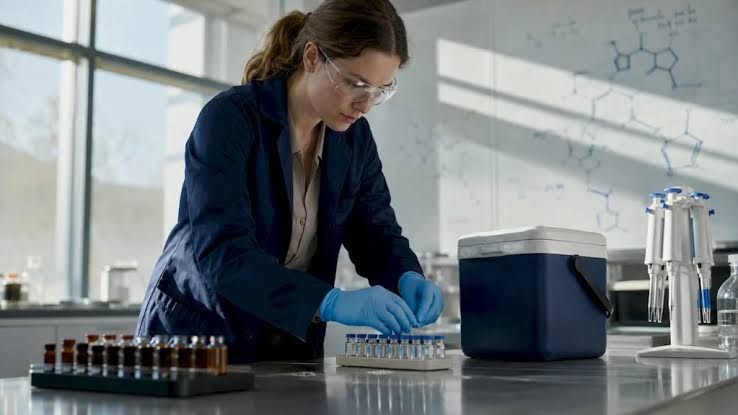
A research peptide is only as good as the way it is stored. A vial that left the supplier at 99% purity can lose a meaningful fraction of that within weeks if it sits on a warm shelf, is reconstituted carelessly or is frozen and thawed repeatedly. Peptides are chains of amino acids held together by bonds that heat, moisture, light, oxygen and microbial contamination all work to break. The degradation is invisible: the powder still looks like powder and the solution still looks clear, which is why so many “this peptide didn’t work” complaints trace back to storage rather than to the material itself.
The good news is that protecting peptides is not complicated. It comes down to a dozen habits that any small laboratory, including a home research setup, can adopt with minimal equipment. Most of them cost nothing beyond attention. The rules below cover the full lifecycle: receiving a shipment, storing lyophilised powder, reconstituting it correctly, storing the solution, avoiding contamination and keeping the records that make experiments reproducible.
Everything here is laboratory practice for handling research reagents. Peptides such as Retatrutide, BPC-157 or CJC-1295 sold by research suppliers like NOX Peptides Canada are intended for laboratory use only, are not approved by Health Canada or the FDA for human use, and nothing in this article is medical advice or an instruction for self-administration.
1. Inspect and log every shipment on arrival
Storage begins the moment a parcel arrives. Open it promptly and check three things: that the vial labels match the order and the certificate of analysis, that seals and caps are intact, and that the lyophilised powder is a dry cake or powder rather than a collapsed, glassy or wet-looking residue. A cake that has slumped or looks partly dissolved may have been exposed to moisture or heat in transit.
Record the date received, the lot number and the condition in a log. Domestic shipping helps here. A parcel from a Canadian supplier such as NOX Peptides Canada typically spends two or three days in transit rather than the two or three weeks an international shipment can take, which sharply limits the time the product spends at uncontrolled temperature before it reaches the freezer.
2. Store lyophilised peptides cold, dark and dry
Freeze-dried peptide is the most stable form of the material, but it is not indefinitely stable at room temperature. For storage beyond a few weeks, keep unopened vials in a freezer at approximately minus 20 degrees Celsius. For long-term archival storage of valuable or sensitive peptides, minus 80 is better still, though a domestic freezer is adequate for most research compounds over typical timeframes.
Light and moisture matter as much as temperature. Keep vials in their original boxes or an opaque container, and store them in a sealed bag or tub with a desiccant sachet to guard against condensation. A frost-free freezer cycles its temperature to prevent ice build-up, which adds small repeated warming events; a chest freezer or a dedicated laboratory freezer without a defrost cycle is preferable if available.
3. Let vials reach room temperature before opening
Opening a cold vial in warm, humid air causes water vapour to condense directly onto the powder. That moisture starts hydrolysis and can make the powder clump, which affects both stability and accurate reconstitution. Allow a vial to sit sealed at room temperature for at least fifteen to thirty minutes before removing the cap or piercing the septum. The same applies to vials of reconstituted solution taken from the refrigerator: give them a few minutes before opening.
4. Use the right diluent for the intended use
The choice of diluent is determined by what the peptide will be used for and how long the solution needs to last.
- Bacteriostatic water (water with 0.9% benzyl alcohol) suppresses microbial growth and is the usual choice when a reconstituted solution will be stored and drawn from over days or weeks.
- Sterile water for injection contains no preservative and is suited to single-use preparation where the solution is consumed at once.
- Buffers such as PBS or acetate are used in analytical and cell-culture work where pH control matters; some peptides are poorly soluble in neutral water and require a small amount of dilute acetic acid or a similar co-solvent to dissolve.
Check the supplier’s notes and the peptide’s known solubility. Lipidated peptides, including Retatrutide, Semaglutide and Tirzepatide analogues, can behave differently from small unmodified peptides and may need a moment longer to fully dissolve.
5. Do the reconstitution arithmetic before adding anything
Reconstitution is a simple mass-over-volume calculation, but errors are common because people estimate rather than calculate. The formula is concentration equals total peptide mass divided by diluent volume. Some worked examples:
- A 5 mg vial plus 2 mL of diluent gives 2.5 mg/mL, or 2,500 micrograms per mL.
- A 10 mg vial plus 2 mL gives 5 mg/mL.
- A 30 mg vial, which is the size NOX Peptides Canada supplies for Retatrutide, plus 3 mL gives 10 mg/mL; the same vial plus 6 mL gives 5 mg/mL.
On a standard 1 mL insulin-type syringe marked in 100 units, each unit represents 0.01 mL, so a 10 mg/mL solution contains 100 micrograms per unit. Writing the concentration on the vial label the moment it is prepared removes the risk of forgetting what dilution was used. This is laboratory arithmetic for preparing stock solutions; it is not guidance on administering anything to a person.
6. Add diluent gently and never shake
Peptides are sensitive to mechanical stress. Direct the stream of diluent down the inside wall of the vial rather than onto the powder, then let the vial stand or swirl it gently until the cake dissolves. Vigorous shaking creates foam, and the air-liquid interface in foam can denature or aggregate peptide molecules. If a peptide is slow to dissolve, patience and gentle rotation work better than agitation; a brief rest in the refrigerator sometimes helps for stubborn material.
Vortex mixers and ultrasonic baths, common in analytical laboratories, should be used cautiously with peptides. A few seconds of low-intensity sonication can help disperse a poorly soluble cake, but prolonged sonication heats the sample and can fragment or aggregate the peptide. If sonication is used at all, keep it brief and keep the vial cool.
7. Refrigerate reconstituted solutions and use them within a defined window
Once in solution, a peptide is far less stable than in lyophilised form. Store reconstituted vials in a refrigerator at 2 to 8 degrees Celsius, protected from light. A reasonable working assumption for most research peptides in bacteriostatic water is that the solution remains usable for a few weeks; some peptides are more fragile, and some are considerably more robust, but in the absence of specific stability data, shorter is safer.
Mark the reconstitution date on the vial and set a discard date. A solution that develops cloudiness, visible particles or discolouration should be discarded regardless of age, since these are signs of aggregation, precipitation or contamination.
8. Avoid repeated freeze-thaw cycles
Freezing a reconstituted peptide solution is possible, but each freeze-thaw cycle causes ice crystal formation and concentration gradients that damage the peptide. If a solution must be frozen for longer storage, divide it into single-use aliquots first so that each portion is thawed only once. Small polypropylene tubes with tight caps are suitable. Label every aliquot with the peptide name, concentration, date and lot number. Never refreeze a thawed aliquot.
When thawing, move the aliquot from the freezer to the refrigerator or let it warm slowly at room temperature rather than heating it. Rapid warming creates temperature gradients within the tube that can promote aggregation, and warming in a water bath introduces the risk of contamination through the cap seal. Once thawed, treat the aliquot like any other refrigerated solution and use it within a short window.
9. Maintain aseptic technique at every step
Bacteriostatic water slows microbial growth; it does not sterilise a contaminated vial. Contamination introduced during reconstitution or repeated draws will degrade the peptide and can compromise any downstream assay.
- Wipe the vial septum with an alcohol swab before every puncture and let it dry.
- Use a fresh sterile needle and syringe for every draw. Do not reuse needles between vials, which also cross-contaminates lots.
- Work on a clean surface, ideally with a laminar-flow hood or at least away from drafts, open windows and food preparation areas.
- Minimise the number of punctures per vial; each one is an opportunity for contamination and each one slightly damages the septum.
10. Protect against light and oxidation
Certain amino acids, notably methionine, tryptophan, cysteine and histidine, are susceptible to oxidation, and ultraviolet light accelerates both oxidation and other degradation pathways. Amber vials or an opaque box solve the light problem. For oxidation-sensitive peptides in solution, minimising headspace in the storage container reduces oxygen exposure; some laboratories overlay with nitrogen or argon, though this is beyond what most home setups need. Keeping solutions cold is the most practical anti-oxidation measure available.
11. Handle pH and buffer compatibility deliberately
Peptides have preferred pH ranges. Many are most stable in slightly acidic conditions and degrade faster at neutral or alkaline pH; others are the reverse. Deamidation of asparagine and glutamine residues, one of the most common chemical degradation routes, speeds up as pH rises. If a peptide is being prepared for an analytical or cell-based experiment in a buffer, check its known stability profile and avoid holding it for extended periods at a pH where it is unstable. Prepare working dilutions in buffer close to the time of use rather than days ahead.
12. Keep records that make experiments reproducible
A laboratory notebook is a storage tool. For every vial, record:
- Peptide name, supplier and lot number, cross-referenced to the certificate of analysis on file.
- Date received and condition on arrival.
- Date reconstituted, diluent used, volume added and resulting concentration.
- Storage location and temperature.
- Each date of use and the volume withdrawn.
- Discard date and reason.
When a result is unexpected, this record is what allows a researcher to distinguish a real finding from a storage artefact. It also allows problems to be traced back to a specific lot and reported to the supplier. Suppliers that publish per-batch third-party COAs, such as NOX Peptides Canada, make this traceability possible; without a lot number and a matching certificate, there is nothing to trace.
Frequently Asked Questions
How long can a lyophilised peptide stay at room temperature?
Short periods, on the order of days to a few weeks, generally cause little measurable loss for most peptides. Shipping is designed around this. Beyond that, refrigeration or freezing is needed to preserve purity.
Is the refrigerator adequate for unopened vials?
For weeks to a few months, yes. For longer storage, a freezer at minus 20 or colder is better. Either way, keep vials dry and dark.
What does it mean if the powder looks different from the last vial?
Lyophilised cakes vary in appearance between batches depending on the freeze-drying process; a fluffy cake and a fine powder can be the same peptide. A wet, glassy or collapsed appearance, however, suggests moisture or heat exposure and warrants caution.
Can Retatrutide be stored the same way as other research peptides?
The general rules apply: cold, dark and dry as a powder, refrigerated and used within a defined window once in solution. As a lipidated peptide it may take slightly longer to dissolve and benefits from low-binding labware. It is a research-use-only reagent, not approved for human use.
Final Thoughts
Storage and handling determine whether the purity figure on a certificate of analysis still describes the material at the moment it is used. Inspecting shipments, freezing lyophilised powder, letting vials warm before opening, choosing the right diluent, calculating concentrations before reconstituting, avoiding shaking, refrigerating solutions, aliquoting instead of refreezing, working aseptically, protecting from light, respecting pH and keeping thorough records are twelve habits that together preserve the reagent and the credibility of any experiment that uses it.
Those habits work best when the starting material is well documented. Canadian researchers can shorten transit time and gain lot-level traceability by sourcing domestically from NOX Peptides Canada, which publishes third-party COAs for each batch, ships within Canada and stocks Retatrutide 30 mg alongside other research peptides. All such products are for laboratory research only, are not approved by Health Canada or the FDA for human use, and nothing in this guide should be read as medical advice.
