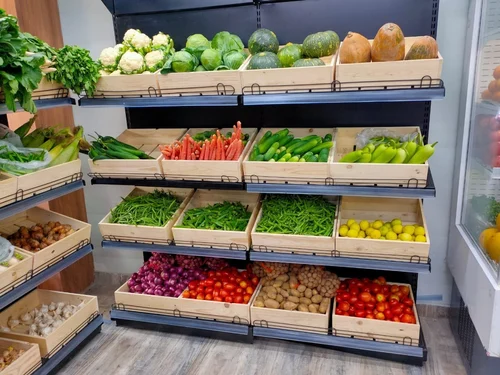
For anyone running a grocery store, a produce section, or an outdoor market stall, the way vegetables are displayed has a direct bearing on how quickly stock moves and how much of it ends up as waste. This is not a question of aesthetics alone. The physical structure holding your produce affects airflow around the product, how customers interact with it, how staff restock it, and whether the setup holds up across a full trading day. Choosing the wrong configuration creates friction at every one of those points. Choosing well makes operations simpler, quieter, and more consistent.
The challenge is that most buyers approach this decision reactively. A rack breaks, takes up too much floor space, or simply stops working for the volume of product being moved, and a replacement is sourced quickly without much structural thinking. That reactive approach tends to produce the same problems over a slightly longer cycle. This guide works through the core considerations that should inform the decision before a purchase is made, not after.
Understanding What a Vegetable Display Rack Actually Does in a Retail Environment
A vegetable display rack is more than a holding structure. It is a working part of a retail operation that affects product condition, customer behavior, restocking efficiency, and floor space management simultaneously. When buyers treat it as simple furniture, they tend to underspecify it relative to what the operation actually demands. Understanding its functional role makes the selection criteria much clearer.
When evaluating options, looking at a dedicated range of vegetable display rack configurations designed for retail and market environments gives a useful baseline for understanding how different formats address different operational realities. The differences between a tiered floor unit, a wall-mounted configuration, and a modular market stall frame are not cosmetic. Each one places different demands on your space, your restocking workflow, and your product presentation.
Produce retail also has a specific challenge that other product categories do not. Vegetables are perishable, irregular in shape, and variable in weight across different seasonal lines. A display structure that works well for uniform packaged goods may not handle loose root vegetables or leafy greens with the same effectiveness. The structure needs to be evaluated against the actual product profile it will carry, not against a generic retail assumption.
The Role of Airflow and Product Condition
One of the least discussed but most operationally significant factors in display rack selection is airflow. Produce that is stacked in a closed or poorly ventilated structure deteriorates faster. This is not a quality complaint — it is a direct commercial cost. Increased waste margins, more frequent rotation cycles, and reduced shelf life all flow from a display configuration that traps heat and moisture around the product.
Open-sided or slatted rack designs manage this considerably better than solid-shelf alternatives. This is particularly relevant in indoor environments where refrigeration is not in use. If your store or stall operates at ambient temperature, the structure itself becomes a variable in how long your stock remains in acceptable condition.
Customer Access and How It Affects Purchase Volume
The physical accessibility of a display structure influences purchasing behavior in a straightforward way. When customers can reach product without difficulty, interact with it naturally, and see the full range of what is available without obstruction, they purchase more and move through the section more efficiently. When the structure creates awkward angles, restricted reach, or poor visibility of lower tiers, customers disengage and move on.
This is particularly relevant in high-footfall environments where the pace of customer movement is fast. A display that requires customers to pause and work around other shoppers to access a lower shelf creates a friction point that is easy to avoid with the right rack geometry.
Matching the Rack Format to Your Physical Environment
No display configuration is universally optimal. The right format depends heavily on the physical constraints and operational flow of the specific environment where it will be used. A format that performs well in a large indoor grocery store may be entirely impractical for a market stall with limited floor space and no fixed infrastructure to anchor against.
Indoor grocery environments typically have more flexibility in terms of floor space allocation and the ability to use fixed or semi-permanent structures. This allows for larger tiered units, gondola-style configurations, or wall-mounted shelving that integrates with the broader store layout. The primary constraints in these settings are aisle width, customer flow direction, and refrigeration adjacency for product categories that need it.
Outdoor and Market Stall Configurations
Outdoor market stalls and temporary retail environments operate under a different set of constraints. Portability, setup time, and structural stability without fixed anchoring all become significant. A rack that takes two people forty minutes to assemble is a real operational problem when setup happens before trading hours under time pressure.
Foldable or collapsible frame designs address the portability requirement, but they need to be evaluated for stability under product load and in variable weather conditions. A structure that shifts or vibrates in light wind is a safety and presentation concern. Weight distribution across multiple tiers also matters more in portable configurations where the base footprint may be smaller relative to the total load.
Floor Space Efficiency and Vertical Use
Retailers and stallholders operating in constrained environments often underuse vertical space while struggling with floor congestion. Tiered display racks that step upward allow for meaningful product volume to be displayed within a small footprint. This works particularly well for smaller produce items — root vegetables, onions, citrus — where stacking in open bins on graduated tiers is both practical and visually clear to customers.
The trade-off with taller configurations is restocking accessibility. A top tier that requires staff to reach or use a step creates a workflow inefficiency that compounds across the day, particularly in busy trading periods. The height range of a configuration should be matched realistically to the staff who will be managing it.
Material and Construction Considerations for Longevity
The material a vegetable display rack is made from directly affects how long it will remain serviceable and how much maintenance it will require. Produce environments involve moisture, cleaning chemicals, and the physical stress of regular restocking. A structure that degrades quickly under those conditions becomes a recurring cost rather than a capital investment.
According to the Food Standards Agency’s guidance on food hygiene for businesses, surfaces and equipment in contact with or adjacent to food products must be durable, cleanable, and resistant to contamination. While a display rack is not always in direct food contact, it sits within that hygiene environment and should be selected accordingly.
Metal Frames Versus Composite and Plastic Alternatives
Powder-coated steel and aluminium frames are the most common structural materials in commercial produce display. Steel offers strength and load-bearing capacity at a relatively low cost but requires protective coating to resist corrosion in damp environments. Aluminium is lighter and naturally more resistant to corrosion, which makes it a practical choice for outdoor or portable setups, though it carries a higher unit cost.
Plastic and composite shelving components are increasingly common as bin and basket inserts within metal frame systems. These components are lightweight, easy to clean, and replaceable independently of the frame if damaged. The combination of a durable metal frame with interchangeable plastic bins offers a practical balance between longevity and maintenance cost.
Stability and Load Distribution
Produce display racks carry significant and variable loads. A fully stocked unit holding multiple varieties across several tiers can weigh considerably more than the same structure empty. A rack that flexes, leans, or shifts under full load is both a safety concern and a presentation problem. Stability should be assessed under realistic loading conditions, not just when the unit is empty.
Base design matters significantly here. Wide-footed frames with non-slip feet or rubber pads perform better on smooth retail floors than narrow-based units that rely entirely on weight distribution. For outdoor use, the ability to stake or sandbag the base adds an additional layer of operational security.
Hygiene, Cleaning, and Operational Maintenance
A display structure in a produce environment needs to be cleanable quickly and completely. Organic material — moisture, soil, leaf debris — accumulates in corners, joints, and underneath bins. If the structure is difficult to clean thoroughly, that material becomes a hygiene concern and eventually a customer-visible problem.
Racks with fewer tight joints, removable bin components, and smooth inner surfaces clean faster and more completely. This is an operational consideration, not just a hygiene one. If cleaning takes significantly longer because of the rack design, it either happens less thoroughly or takes staff time away from other tasks. Neither outcome is acceptable in a working retail environment.
Component Replaceability
No display structure lasts indefinitely. Bins crack, frames bend, and connection points wear under daily use. A configuration where individual components can be replaced without replacing the entire unit extends the effective life of the investment considerably. Before purchasing, understanding whether parts are available and at what lead time is a practical step that most buyers skip.
Concluding Thoughts on Making the Right Selection
Choosing a vegetable display rack is fundamentally an operational decision dressed as a purchasing one. The right selection reduces waste, supports restocking efficiency, fits the physical environment, and holds up over time without becoming a maintenance burden. The wrong one does the opposite, quietly and repeatedly.
The decision becomes clearer when it is approached from the working reality of your specific setup — the volume of product you carry, the floor space you have, the staff who manage it daily, and the customers who interact with it. When those factors are the starting point, the format, material, and configuration that fits will narrow considerably on its own.
There is no single best rack for every environment. But there is almost always a clearly better choice for a given one, and reaching that choice comes from asking the right operational questions before the purchase, not troubleshooting the wrong one afterward.