
Every Helix Forge product in Canada is tested to be of high quality. It undergoes a series of tests to ensure this. Purity is a measurable percentage, calculated from independent lab testing, tied to a specific production batch. And that is exactly what they live up to.
But if you’re still wondering whether their compound is suitable for laboratory research, this guide will be the answer to that. After all, without that number and the testing behind it, “pure” is just a word on a product page.
So see for yourself why Helix Pure Peptides is the standard for quality compounds in the market today!
What peptide purity actually means
Purity is typically expressed as a percentage, calculated from HPLC testing that measures how much of a sample is the target compound versus leftover impurities from the manufacturing process.
A peptide listed at 99% purity means the testing found the target molecule accounted for roughly that share of everything detected in the sample. The remaining fraction is usually a mix of synthesis byproducts, unreacted starting material, or trace degradation products, none of which show up in a simple percentage without the underlying test data.
That number is only meaningful if it comes with the testing data behind it. A purity percentage with no supporting chromatogram or batch reference is a claim, not a result, and there is no way to tell whether it reflects one especially clean batch or the typical output across a supplier’s actual production.
Why a purity claim without data is not verifiable
Plenty of peptides supplier advertise high purity as a general selling point rather than a batch-specific result. That approach is common across the research peptide market, and it leaves a researcher with nothing to check the claim against beyond the supplier’s own marketing language.
A product page that states “99% pure” without a batch number, a testing method, or a downloadable CoA is describing an aspiration, not reporting a measurement.
A verifiable purity claim looks different. It includes:
- A specific percentage, not a rounded or vague range.
- The testing method used to arrive at that number, typically HPLC.
- A batch or lot reference tying the result to the exact compound being purchased.
None of that is complicated to provide. It simply requires testing every batch rather than testing occasionally and marketing the best result across an entire product line.
What purity alone does not confirm
A high purity percentage says a compound is mostly free of impurities. It does not confirm the compound is actually what the label claims. Identity confirmation, usually through mass spectrometry, is a separate test that verifies molecular structure. A peptide can technically test as pure while still being the wrong compound entirely, since a purity test measures how clean a sample is, not what the sample actually is.
This is why purity and identity testing are meant to work together, not stand in for each other. A supplier that only reports one of the two is only answering half the question a researcher actually needs answered.
How Helix Forge Canada verifies purity for every batch
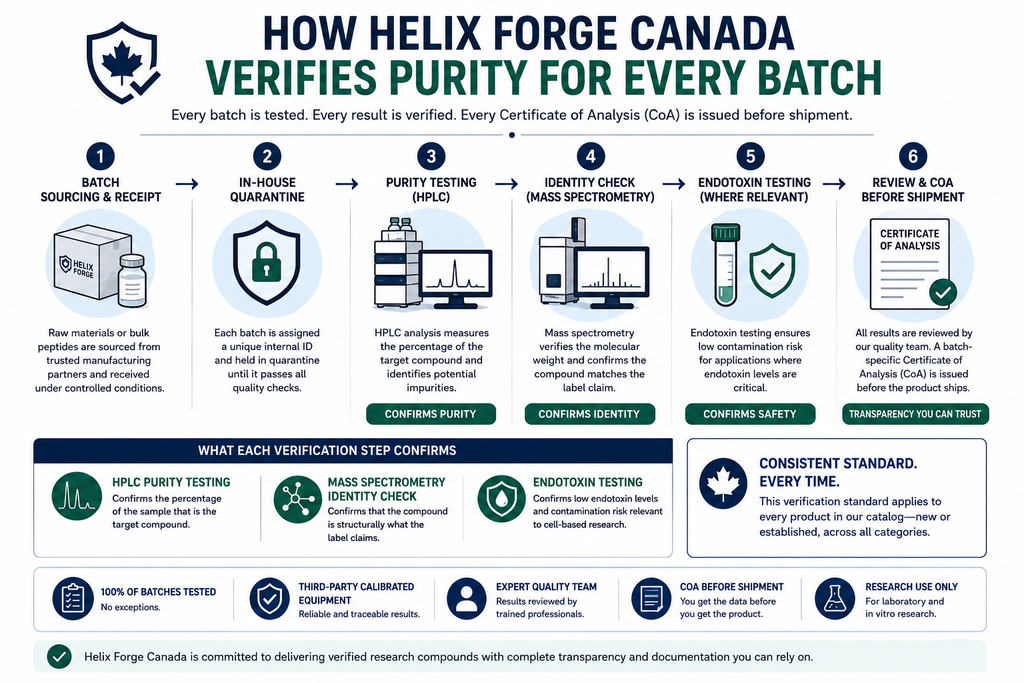
Helix Forge Canada tests every batch across its catalog for purity, identity, and, where relevant, endotoxin levels, and issues the resulting CoA before the compound ships. That standard applies the same way whether a compound has been in the catalog for years or was added recently, and it does not vary based on how competitive a particular product category happens to be.
| Verification step | What it confirms |
| HPLC purity testing | The percentage of the sample that is the target compound |
| Mass spectrometry identity check | That the compound is structurally what the label claims |
| Endotoxin testing | Contamination risk relevant to cell-based research |
What to check before trusting a purity claim from any supplier
A few checks apply regardless of which peptide supplier in Canada a researcher is evaluating. None of these require special equipment or lab access to perform, since they are checks on the documentation itself rather than independent testing.
- Ask whether the purity percentage is backed by a batch-specific CoA, not a general product description.
- Confirm the testing method is disclosed, not just the resulting number.
- Check whether identity confirmation is included alongside the purity result.
- Confirm the documentation is available before the order ships.
A supplier willing to show this level of detail before a purchase is a stronger signal than any purity number printed alone.
Key Points
A purity claim is only as good as the documentation behind it. Helix Forge ties every purity figure to independent testing and a batch-specific CoA, issued before the order ships, so the number reflects a verified result rather than a marketing line. Review the CoA-verified catalog at helixforge.co to see the testing behind a specific compound’s purity before ordering.
Frequently asked questions about peptide purity
What does peptide purity actually mean?
Peptide purity is a percentage, calculated through HPLC testing, that measures how much of a sample is the intended compound versus leftover impurities from manufacturing.
Is a high purity percentage enough to trust a compound?
Not on its own. Purity confirms how clean a sample is, but identity confirmation through mass spectrometry is a separate test needed to verify the compound is structurally what the label claims.
Why do purity claims vary so much between suppliers?
Some suppliers test every batch and provide the documentation. Others advertise a general purity standard without batch-specific testing behind each claim, which leaves the number unverifiable and makes it impossible to know whether it reflects the actual batch being purchased.
What should be included with a purity claim to make it trustworthy?
A specific percentage, the testing method used, a batch reference tying the result to the exact compound purchased, and ideally an identity confirmation test alongside it.
