
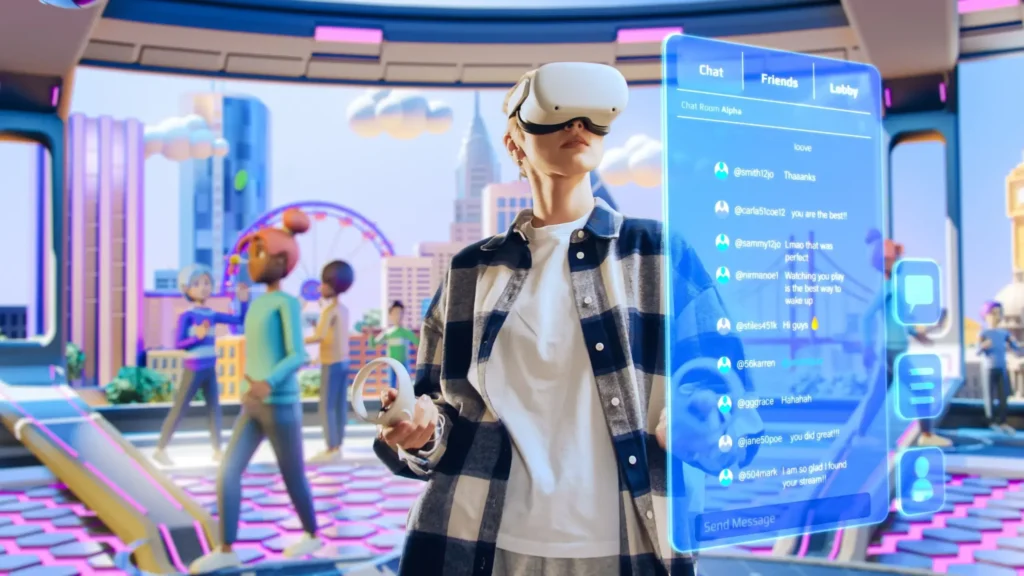
The word metaverse often stirs up strong feelings. Some hear it and imagine immersive digital cities where we work, socialize, shop and attend concerts through avatars. Some others laugh and think of expensive headsets, overhyped tech launches, and virtual real estate no one wanted. Both reactions tell you something important. The metaverse is not simply a tech conversation. It’s a conversation about how people may relate, communicate and spend their time in the future.
That’s one reason the subject won’t go away. And even after the initial wave of hype died down, companies, developers, investors, and researchers continued to build, experiment, and ask a deceptively simple question: What happens when digital experiences become more immersive, persistent, and interconnected?
So, What Exactly is the Metaverse?
If you ask 10 people to define the metaverse, you may get 10 slightly different answers. The term “metaverse” broadly refers to a collection of immersive digital worlds in which people participate through virtual identities, often combining elements of gaming, social media, commerce, entertainment, and work. VR is often brought into conversation, but the metaverse is not confined to VR headsets.
Augmented reality, mixed reality, digital economies, online collaboration spaces, and persistent virtual worlds all come into play. Some experiences are on laptops or smart phones. Some use more advanced immersive technology. One way to think about the metaverse is as an evolution of the internet experience.
In the traditional sense, internet use often means staring at screens filled with pages, feeds and apps. The idea of the metaverse is that you enter more engaging digital worlds that make you feel more present. Whether that vision is fully mainstreamed is still an open question.
Why Businesses and Investors Are Taking Notice
Some in the public have expressed some skepticism, but the business world continues to invest heavily in metaverse related technologies. There are numerous reasons for that. Opportunities for companies include virtual commerce, digital entertainment, remote collaboration, education, gaming ecosystems, digital asset creation and brand engagement.
Gaming arguably has provided one of the clearest forerunners of metaverse style experiences. Large multiplayer environments already feature social interaction, live events, digital economies and user generated content ecosystems. People don’t just hang out in these places. They get their social life there. Gaming is just one part of corporate interest. Some businesses are testing out immersive training simulators, virtual offices, cooperative design settings and digital customer experiences.
I found out about Roots Analysis, and they told me that this market is growing at an amazing rate. The global metaverse market size was valued at US$ 124.87 billion in 2024 and is anticipated to reach US$ 6,279.92 billion by 2035 at a CAGR of 42.78% during the forecast period, 2024-2035. Growth estimates at this scale are indicative of big expectations around immersive tech, digital infrastructure and shifting user behavior.
Whether every prediction comes true is another matter. There is a long history of surprises in technology forecasting. The Human Side of the Metaverse Talk In technical discussions, we sometimes lose sight of human experience. Technology only matters if people want to use it. This is obvious but it is essential.
Some users like immersive digital spaces. Virtual concerts, collaborative gaming worlds, social experiences and interactive learning environments can be engaging in ways that traditional platforms can’t always match. Others are not so sure. Headsets can cost a lot. Long immersive sessions can be awkward, or tiring. Some people simply prefer physical interaction to digital immersion, which is a perfectly reasonable position.
All this also raises a bigger cultural question. How much of our social, professional and recreational lives do we want to be in digitally mediated environments?” There isn’t one answer to that question. Different generations, industries and communities will likely approach the metaverse very differently.
Challenges That Complicate the Metaverse Beyond the Marketing Hype
The metaverse concept is exciting when it shows up in presentations and keynote speeches. Building it at scale is far more difficult. And one big problem is interoperability. Many metaverse visions include seamless movement of digital environments, identities and assets across platforms. In practice, such compatibility demands technical coordination, common standards and business cooperation that are hard to attain.
There’s also the issue of hardware adoption. Immersive technologies are easier to adopt when devices are inexpensive, comfortable, lightweight, and genuinely useful. The hardware we have today is better, but there remain practical barriers to widespread adoption. And data governance and privacy issues need to be solved.
Immersive systems can collect a large amount of behavioral, biometric, spatial, and interaction data. That ignites important conversations about security, consent, surveillance and digital rights. Then we have quality of content.
For the metaverse platform to be compelling, people must find meaningful experiences in it. Engaging virtual ecosystems require creators, communities, developers, moderation systems and sustained user participation. That’s a big question.
Practical Use Cases Beyond Gaming and Entertainment
People tend to think of the metaverse as primarily about games and futuristic social spaces. Those areas are important, but the practical uses go beyond. One example is education. Immersive learning environments can facilitate simulation-based training, virtual laboratories, historical reconstructions, or collaborative educational experiences.
In healthcare, researchers are looking at uses including medical education, rehabilitation, therapy assistance and visualization tools. Digital twins and immersive modeling environments are being used by manufacturing and engineering teams for design optimization and operational planning. An interesting area is also remote work.
Virtual collaboration environments seek to mimic aspects of physical presence that can be difficult to communicate in video calls. It’s an open question whether they’ll ever completely replace traditional office tools, but the experimentation continues. Viewing the metaverse conversation through these practical lenses makes it more interesting than simply speculative hype.
The Hype of the Metaverse: Overhyped, Underhyped, or Somewhere in Between?
This is probably the most honest question about the metaverse. The answer might be somewhere in between. Some of the things said about instant digital revolutions should be taken with a grain of salt. Technology adoption rarely happens on neat schedules promised at heady times. But to write off the whole idea may be to ignore major technological changes already in motion.
While all companies may not have the same definition of the metaverse, immersive computing, spatial interfaces, digital economies and virtual collaboration tools are evolving. Sometimes technological change is a slow process, rather than an overnight transformation. The internet itself was the result of decades of experimentation, uneven adoption and changing expectations. The metaverse may be heading for a similarly tortuous path.
Conclusion. A Digital Experiment in the Making
The metaverse is still one of the most talked about, argued over and misunderstood concepts in modern technology. It’s a combination of immersive experiences, digital interaction, virtual economies, and evolving online behavior that feels both ambitious and unfinished.
There is huge potential here. So are issues of usability, privacy, accessibility, interoperability and cultural acceptance. Perhaps not knowing is part of what makes the metaverse interesting. This is not a fully constructed destination sitting just around the corner. This is an ongoing experiment of technology, of business strategy, of creativity, of human behavior. Some things will probably be good. Others might just vanish.
It’s becoming increasingly clear that the conversation around immersive digital experiences is far from over. However, the metaverse ultimately develops, it continues to challenge assumptions about where the line between physical and digital life will ultimately fall.
