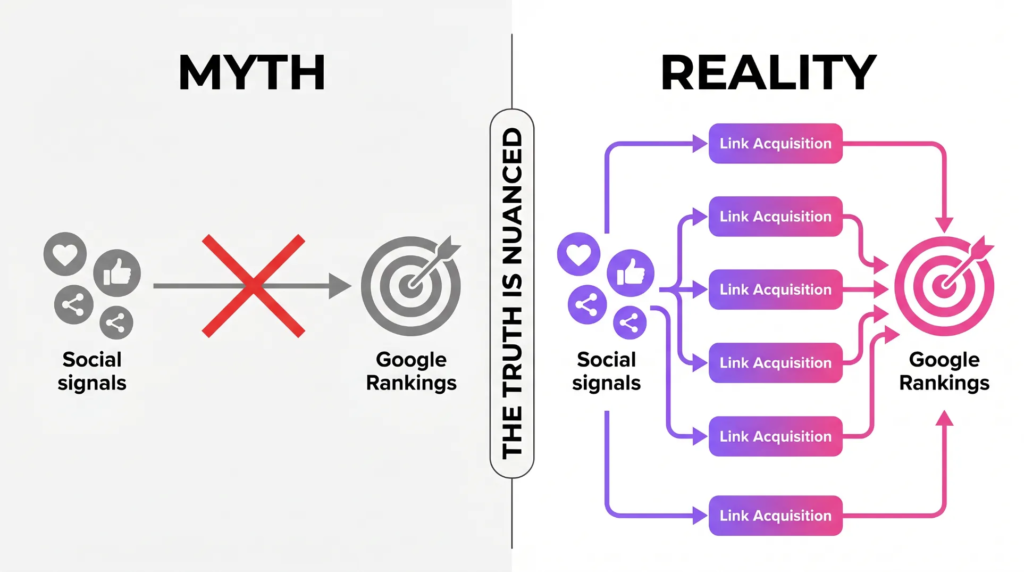
Search “social signals and SEO” and you will find contradictory advice everywhere. Some experts swear social media directly affects Google rankings. Others claim it is completely irrelevant. Google itself says social signals are not ranking factors. Yet brands with strong social presence consistently rank higher. This disconnect creates confusion for anyone trying to understand whether their social media presence actually affects rankings. The truth is more nuanced than either extreme claims. Social signals do not directly influence rankings the way backlinks do. But they create indirect effects that absolutely impact SEO performance through measurable mechanisms. Understanding this distinction changes everything about how you approach social media for search visibility.
Here is what the evidence actually shows about social signals, SEO, and the real relationship between them.
What Google Actually Says About Social Signals
Let us start with the official position.
Google’s Consistent Statement
Google representatives have repeatedly stated that social signals are not direct ranking factors. Matt Cutts said it in 2014. Gary Illyes confirmed it in 2016. John Mueller reiterated it in 2021.
Their reasoning: Google cannot reliably access social media data. Facebook content is mostly private. Twitter limits API access. Instagram blocks crawlers. Google cannot index what it cannot see.
Therefore, Google claims it does not use likes, shares, followers, or engagement as ranking signals.
Why This Makes Technical Sense
Social signals are easily manipulated. Anyone can buy followers or engagement. If Google used these as ranking factors, SEO would become a pay-to-win game.
Social data is unstable. A viral post might get 100,000 shares then disappear. Google prefers stable, persistent signals like backlinks.
Platform access is unreliable. Twitter could change API access tomorrow. Google cannot build ranking systems on data they do not control.
What the Data Actually Shows
Official statements are one thing. Observable reality is another.
The Correlation Studies
Multiple studies found strong correlation between social signals and rankings:
Moz analyzed 1 million search results. Pages with more social shares ranked higher. The correlation was significant.
Cognitive SEO found Facebook shares correlated with higher rankings more than any other single factor except backlinks.
Hootsuite research showed brands with strong social presence ranked better for branded and non-branded keywords.
The Critical Distinction
Correlation does not prove causation. High-quality content gets both social shares and high rankings. That does not mean shares cause rankings.
But correlation this consistent suggests something real is happening. Even if not direct causation.
The Indirect Effects That Actually Matter
Social signals create measurable SEO impacts through indirect mechanisms.
Indirect Effect 1: Link Acquisition – Content shared on social gets seen by more people including bloggers and journalists. More visibility leads to natural backlinks. Studies confirm: content with high social shares acquires backlinks faster.
Indirect Effect 2: Brand Search Volume – Strong social presence builds brand awareness, driving branded searches. Google interprets rising branded searches as authority signals. A company with 100K engaged followers generates more branded searches than one with 1K.
Indirect Effect 3: Traffic and Engagement Metrics – Social media drives traffic that exhibits better behavior: improved CTR when brand is recognized, increased time on site from pre-qualified visitors, decreased bounce rate. These user engagement signals absolutely influence rankings.
Indirect Effect 4: Content Discovery and Indexing – Social shares accelerate Google’s content discovery. Faster indexing means faster ranking opportunities.
Indirect Effect 5: E-E-A-T Signals – Strong social presence contributes to perceived expertise and authority. Google’s quality raters evaluate social profiles. A verified account with 50K followers signals more authority than anonymous presence.
Platform-Specific SEO Impact
YouTube – Direct SEO value. YouTube is Google-owned and the second-largest search engine. Videos appear in Google results and rank for competitive keywords. Services to buy YouTube views can jumpstart visibility, leading to organic growth that improves both YouTube and Google rankings.
LinkedIn – Profiles and pages rank in Google. Content gets indexed quickly. Well-optimized LinkedIn articles can rank for competitive keywords. Provides direct SERP real estate plus authority signals.
Twitter – Gets indexed faster than most content. Tweets sometimes appear in real-time search results. Drives traffic, generates links, increases brand searches.
Facebook – Rarely indexed but drives massive traffic. That traffic influences user engagement metrics positively.
Instagram – Content rarely appears in Google but builds powerful brand recognition, increasing branded searches and click-through rates.
The Myth vs Reality Breakdown
Let us separate fact from fiction clearly.
Myth: Social Shares Directly Improve Rankings
Reality: No evidence supports this. Google has denied it repeatedly. Correlation studies do not prove causation.
Myth: Social Media Is Irrelevant to SEO
Reality: Completely false. Indirect effects are substantial and measurable.
Reality: Social Signals Trigger SEO-Positive Chains
Social visibility leads to link acquisition, brand searches, traffic, engagement improvements, faster indexing, and authority signals. All of these affect rankings.
Reality: Integrated Strategy Works Better
Treating social and SEO as separate channels wastes potential. Integrated social media growth services amplify SEO results when executed strategically.
How to Leverage Social for SEO Benefits
Practical application of this knowledge.
Strategy 1: Optimize Social Profiles for Search
Your social profiles often rank for your brand name. Optimize them:
Complete all profile fields. Use keywords naturally in bios. Link to your website. Include location information. Use branded hashtags consistently.
These profiles provide SERP real estate you control. Make them work for you.
Strategy 2: Share Content Strategically
Do not just post links. Share content with compelling hooks that encourage engagement.
Ask questions. Provide value upfront. Use visuals that stop scrolling. Time posts when your audience is active.
Higher engagement increases the likelihood of shares, which increases visibility, which increases link probability.
Strategy 3: Build Genuine Social Authority
Follower count alone means little. Engagement rate matters more.
Focus on: Consistent valuable content. Genuine interactions with followers. Building community rather than audience. Establishing expertise in your niche.
Real authority translates to better E-E-A-T signals and higher likelihood of earning natural links.
Strategy 4: Use Social Listening for Content Ideas
Monitor social conversations about topics in your industry. Create content answering questions people actually ask.
Content addressing real questions gets shared more, linked more, and ranks better. Social listening provides free keyword and topic research.
Strategy 5: Cross-Promote Strategically
Do not just share your content once. Create platform-specific variations:
LinkedIn: Professional insights angle. Twitter: Quick takeaways. Instagram: Visual summaries. YouTube: Video explanations. Facebook: Community discussion starters.
Each platform drives traffic differently. Optimize for each.
Measuring Social Media’s SEO Impact
How do you know it is working?
Metrics to Track
Referral traffic from social to your site. Branded search volume trends. Backlink acquisition rate after social campaigns. Rankings for target keywords over time. Social profile rankings for branded terms.
Attribution Challenges
SEO results take time. Social effects are indirect. Attribution is messy.
But look for patterns. Do social spikes correlate with ranking improvements weeks later? Does content with high social engagement eventually attract more backlinks?
Tools to Use
Google Analytics for referral traffic. Google Search Console for branded search trends. Ahrefs or Semrush for backlink monitoring. Social analytics for engagement tracking.
The Strategic Integration Framework
Here is how to integrate social and SEO effectively.
Content Creation
Create content optimized for both search and social sharing. This means:
SEO optimization: Keywords, structure, technical elements. Social optimization: Compelling hooks, shareability, platform-specific formatting.
Do not choose one or the other. Do both.
Promotion Strategy
When you publish SEO-optimized content, promote it aggressively on social. The social promotion accelerates the benefits:
Faster discovery and indexing. More traffic and engagement signals. Higher likelihood of earning natural backlinks. Increased brand awareness driving branded searches.
Authority Building
Use social media to establish yourself as an authority. Share insights, engage in industry discussions, demonstrate expertise consistently.
This authority translates to better E-E-A-T assessment when Google evaluates your content. It also makes people more likely to link to your content.
Audience Development
Build an engaged social audience that amplifies your content organically. Real communities share content because they find it valuable.
This organic amplification is far more powerful than any single tactic. Working with platforms that help you increase online visibility can jumpstart this process, especially for new accounts overcoming cold start problems.
Common Mistakes That Waste Effort
Mistake 1: Buying Fake Engagement
Low-quality bot engagement helps nothing. It does not generate real traffic, links, or brand searches. Waste of money.
Strategic amplification from quality sources works. Fake engagement from bot farms does not.
Mistake 2: Ignoring Platform-Specific Optimization
Posting identical content across all platforms performs poorly everywhere. Optimize for each platform’s audience and format preferences.
Mistake 3: Focusing Only on Follower Count
100,000 fake followers generate zero SEO benefit. 1,000 engaged followers in your niche generate measurable impact through the indirect mechanisms discussed.
Quality beats quantity for SEO purposes.
Mistake 4: Treating Social and SEO as Separate Teams
Silos kill integrated strategy. Social and SEO teams should coordinate on content calendars, keyword research, and promotion strategies.
Mistake 5: Expecting Immediate Results
Social media’s SEO benefits accumulate over time. You will not see ranking jumps after one viral post.
But consistent social presence over months creates compounding benefits.
The Future of Social Signals and SEO
Trends suggest increasing integration.
Google’s Evolving Algorithm
Google increasingly values brand signals. Social presence contributes to brand perception.
As Google moves toward understanding entities (brands, people, topics) rather than just keywords, social authority becomes more relevant.
Social Platforms as Search Engines
TikTok, Instagram, and YouTube increasingly function as search engines. Young users often search these platforms instead of Google.
Optimizing for social search becomes SEO strategy as user behavior evolves.
AI and Entity Understanding
AI-powered search understands context and authority better. Social signals contribute to entity graphs that help AI assess expertise and trustworthiness.
This trend makes social presence more relevant to search visibility, not less.
The Evidence-Based Conclusion
Does your social media presence actually affect rankings?
Direct effect: No. Google does not use likes, shares, or followers as ranking factors.
Indirect effect: Absolutely yes. Social signals trigger chains that measurably impact rankings through link acquisition, brand searches, traffic quality, engagement metrics, indexing speed, and authority signals.
The practical reality: Ignoring social media because “it is not a ranking factor” misses the point entirely. The question is not whether social signals directly influence algorithms. The question is whether social media presence improves search visibility through any mechanism.
The evidence conclusively shows it does. Through multiple pathways. With measurable results.
Smart SEO strategy integrates social media. Not because of mythical direct ranking factors. But because the indirect effects are substantial, proven, and strategically leverageable.
Social signals and SEO work together when you understand the actual mechanisms rather than chasing myths.