
Form: category scorecard — each area ends with a practical “pass / verify / watch” note instead of a generic feature summary
I reviewed SpaceProxy as eight separate operational questions rather than one long feature list. The scorecard covers catalog clarity, entry pricing, onboarding, location control, diagnostic tools, shared-versus-individual choices, scaling mechanics and support expectations. I am deliberately not assigning a fake numerical score; the useful output is whether each category looks ready, needs a live verification step, or deserves caution for a specific type of buyer.
The provider sells fixed shared IPv4, individual IPv4, IPv6/32 and MTProto products with short and long rental periods. That creates a flexible catalog, but flexibility only helps when the buyer maps the right product to the right job. The scorecard format makes those trade-offs visible without pretending that a proxy that is good for localization is automatically good for every marketplace, scraping target or account workflow.
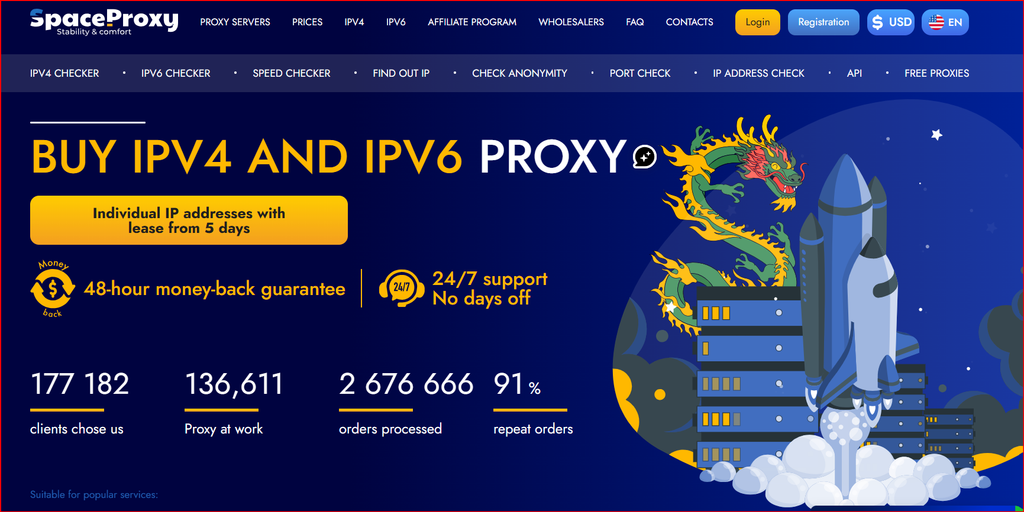
SpaceProxy homepage screenshot used as the visual reference for this scorecard review.
| Scorecard headline SpaceProxy looks strongest on low-cost entry, product variety and self-service diagnostic tools. The categories that still require buyer-side verification are target acceptance, exact geo fit and large-scale management behavior. |
Scorecard 1 — Catalog clarity: PASS
The product families are easy to separate conceptually: Shared IPv4 for the lowest-cost fixed IPv4 access, Individual IPv4 for exclusive use, IPv6/32 for inexpensive scale on compatible targets, and MTProto for Telegram. That is a stronger starting point than a provider that mixes rotating, residential, ISP and datacenter labels without explaining the operational difference. A buyer can identify the intended lane before worrying about location or quantity.
Scorecard 2 — Price flexibility: PASS, with live-check requirement
The current SpaceProxy pricing page publishes short and long rental windows. The snapshot below is useful for comparison, although exact checkout prices should be confirmed immediately before purchase.
| Product | Qty | 5 days | 30 days | 90 days | 360 days |
|---|---|---|---|---|---|
| IPv4 Shared | 1-20 IPs | $0.67 | $0.99 | $2.97 | $11.88 |
| Individual IPv4 | 1-20 IPs | $0.96 | $1.77 | $5.31 | $21.24 |
| Individual IPv4 | 21-40 IPs | $0.91 | $1.74 | $5.22 | $20.88 |
| Individual IPv4 | 41-89 IPs | $0.89 | $1.56 | $4.68 | $18.72 |
| Individual IPv4 | 90-1000 IPs | $0.83 | $1.50 | $4.50 | $18.00 |
| IPv6/32 | 1-99 IPs | $0.10 | $0.51 | $1.53 | $6.12 |
| IPv6/32 | 100-199 IPs | $0.10 | $0.48 | $1.44 | $5.76 |
| IPv6/32 | 200-3000 IPs | $0.09 | $0.48 | $1.44 | $5.76 |
| MTProto | 1-20 IPs | $0.96 | $1.77 | $5.31 | $21.24 |
The five-day option is one of the most practical parts of the price design because it allows a destination-specific pilot. Quantity discounts on individual IPv4 and IPv6 can lower unit cost after the workflow is proven. The key discipline is not to let a bulk discount reverse the correct sequence: test, classify failures, then scale.
Scorecard 3 — Onboarding friction: PASS if inventory is documented
Technically, fixed proxies are simple to deploy: obtain endpoint and credentials, select the protocol supported by the client, test the connection, then add the proxy to the application. Operationally, teams create problems when they skip documentation. I would record project name, product type, country, endpoint, owner, purchase date, expiry date and purpose before the first test. That prevents the same address from being reused across unrelated projects and makes support tickets reproducible.
| Onboarding step | What I would verify | Stop condition |
|---|---|---|
| Authentication | Correct format and credentials | Repeated auth errors |
| Observed IP | Exit address matches assignment | Proxy bypass or wrong endpoint |
| Geo result | Country/region is adequate | Location mismatch for use case |
| Destination | Target loads repeatedly | Block rate makes task uneconomic |
| Application | Real tool works with proxy | Client lacks protocol support |
Scorecard 4 — Location control: VERIFY the exact target market
A provider can offer many countries and still be a poor fit for a job that requires a particular city, ASN, carrier or local-search behavior. For regional SEO, ad checks and marketplace QA, I would test the assigned IP with multiple geo databases and then verify the actual destination experience. Geolocation databases do not always agree, and the website itself may use additional signals. The correct question is not “what country does a checker show?” but “does the target behave as expected for the market I need?”
Scorecard 5 — Diagnostic tools: PASS
SpaceProxy advertises IPv4 and IPv6 checkers, speed checking, IP and anonymity tools, port checking, API access and free-proxy utilities. These tools make the provider easier to troubleshoot because they give a buyer a first diagnostic layer without leaving the site. I would still cross-check with an independent IP/DNS service for important deployments. Provider tools are excellent for diagnosis; independent tools add verification.
Scorecard 6 — Shared versus individual choice: VERIFY by consequence of failure
Shared IPv4 is attractive where occasional reputation variance is tolerable. Individual IPv4 is easier to justify when the cost of a challenge, block or session interruption is high. The correct decision is therefore driven by failure cost rather than by the absolute proxy price. A localization researcher can often tolerate a failed page and retry. A production automation tied to a client SLA may not. This is where a few dollars of extra proxy cost can remove far more expensive operational noise.
Scorecard 7 — Scaling: WATCH management before bandwidth
The first scaling bottleneck is often not network throughput; it is inventory discipline. Once dozens or hundreds of endpoints are involved, the team needs clear assignment, expiry tracking, credential storage, renewal rules and replacement history. API access can help, but automation should come after a naming convention and ownership model exist. Otherwise an API simply accelerates disorder. I would scale in steps and compare error rates at each concurrency level instead of jumping from one working proxy to a large parallel fleet.
Scorecard 8 — Support and refund expectations: VERIFY current terms
The site advertises 24/7 support and a 48-hour money-back guarantee. Those claims are useful, but I would still read the applicable terms for eligibility and exclusions. The best support test is a precise question during the pilot: include endpoint, protocol, client, timestamp and exact error. A support team can do much more with a reproducible 403, authentication failure or port timeout than with the sentence “the proxy does not work.”
Use-case scorecard
| Use case | Starting product | Why | Status |
|---|---|---|---|
| Public-page geo QA | Shared IPv4 | Low cost, fixed viewpoint | Good starting fit |
| Sensitive recurring workflow | Individual IPv4 | Exclusive use | Test destination first |
| Large IPv6-capable lab | IPv6/32 | Very low unit cost | Verify full IPv6 path |
| Telegram | MTProto | Purpose-specific | Verify client stability |
| Automation fleet | Individual/IPv6 | Predictable assignment | Watch ops discipline |
| Strengths | Limitations / checks |
Clear product familiesShort five-day test windowLow unit pricingQuantity discountsStrong self-service diagnostic toolkitAPI-oriented scaling potential24/7 support is advertised | Exact destination acceptance must be provenGeo databases can disagreeShared reputation can varyIPv6 is only useful on compatible pathsLarge fleets require lifecycle managementRefund conditions should be checked in current terms |
Scorecard conclusion
SpaceProxy earns its strongest marks for low-friction entry, product choice and diagnostic visibility. The categories that determine whether it becomes reliable production infrastructure—target acceptance, geo precision and fleet management—still depend on the buyer’s own pilot. My preferred process is to buy the smallest useful order, test the real destination, document the result, and scale only the product lane that passed. Recheck the live catalog on the official SpaceProxy English site before purchasing.
FAQ
What should I test first after purchase?
Authentication, observed exit IP, geolocation and the actual destination in that order.
When should I use Individual IPv4 instead of Shared IPv4?
When exclusive use and lower reputation uncertainty are worth more than the price difference.
Are the provider diagnostic tools enough?
They are useful first-line tools, but important deployments should also be checked with independent IP/DNS services.
Can I scale immediately after one proxy works?
It is safer to increase concurrency in steps and watch error rates, target defenses and internal inventory management.
Is IPv6 the cheapest scaling option?
Often yes on price, but only when the complete software and destination path supports IPv6 correctly.
