
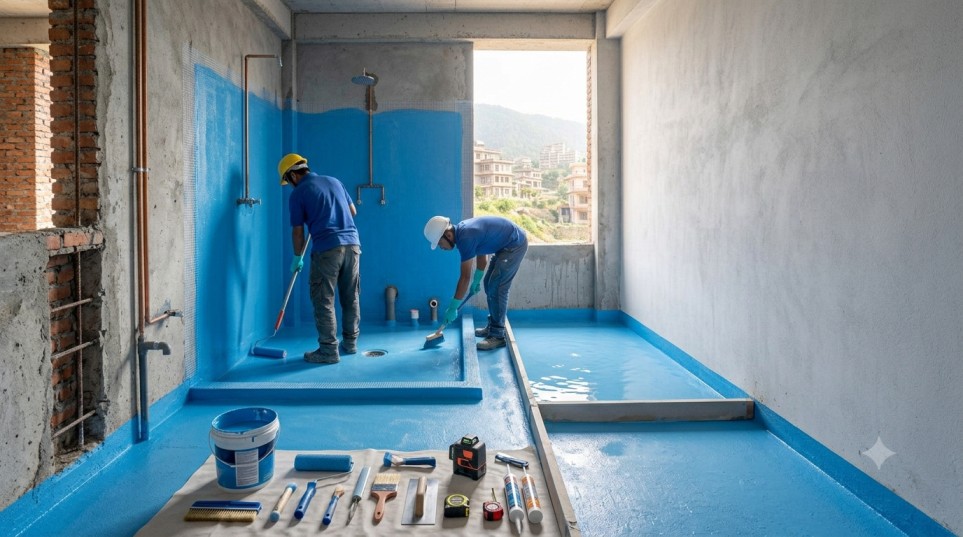
The most consequential part of a bathroom renovation is the part you will never see again. Once the tiles are set, the layer beneath them is sealed away for the life of the room — thirty years if it was built correctly, six or seven if it was not. Everything you use to judge a finished bathroom sits on top of the one component that decides whether it survives. It is also one of the smaller lines on the invoice — commonly 500–1 500 € of a job costing 8 000–15 000 €. That mismatch between cost and consequence is worth understanding before you sign anything.
What vedeneristys is, and what it is not
The vedeneristys (the waterproofing membrane) is a continuous flexible layer applied to the floor and walls of a märkätila (wet room) before any tile goes on. In current Finnish practice it is a liquid-applied product, rolled on in two coats, reinforced with fabric tape at every internal corner, wall-to-floor junction and board joint, and built up to the wet-film thickness the manufacturer specifies. It is a certified system rather than a product: primer, membrane, tapes, collars and adhesive are approved together, and substituting a cheaper tape breaks the approval.
What it is not is tile. Homeowners assume a tiled surface with fresh grout is waterproof. It is not, in either component. The ceramic body is close to impermeable, but the grout between tiles is a porous cement mortar that absorbs and transmits water by design. Silicone in the corners is a movement joint with a service life of a few years — maintenance, not protection. Water crosses a tiled wall continuously, in small quantities, every time someone showers. In a correctly built wet room that is harmless: the moisture travels a few millimetres, meets the membrane, runs down it and leaves through the lattiakaivo (floor drain). Without a membrane, that same water reaches the structure and stays.
Because the consequences land years later and out of sight, this trade is regulated at the level of the individual rather than the company. Owners here checking which local firms actually employ certified installers do that search in Finnish. Kylpyhuoneremontti Turku is the phrase that returns the Turku-area companies themselves, and their Finnish service pages are where certification, scope and warranty length are either stated plainly or conspicuously absent.
Continuous is the whole point
A membrane only works if it is unbroken. It has to cross the entire floor, turn up every wall — typically at least 100 mm, and full height in the shower zone — and be bonded, not merely overlapped, at every transition. The threshold at the door is a classic weak point: the floor level changes there and a hurried installer stops short. So is the join between wall board and the concrete behind a bath. Failures happen at edges, junctions and holes.
The drain collar and the pipe penetrations
The floor drain is where the membrane terminates into a component made by someone else, and it concentrates more failures than any other 20 cm of a bathroom. The membrane has to bond to the drain’s collar or be clamped by its ring, using the adapter designed for that exact drain model. Older drains — and Turku has a great deal of 1960s–1980s stock in Varissuo, Runosmäki and Pansio — are often cast iron, with no usable clamping surface. The honest answer is usually to replace the drain rather than improvise a seal onto it. Improvising is cheaper on the day and is why a slab gets opened a decade later.
Pipe penetrations follow the same logic: every mixer tail and shower riser through a wet wall must be sealed with the system’s own collar before tiling. That logic also explains a rule which surprises people after handover: never drill into a wet wall to hang a shelf or a rail. A screw through a membrane is a hole in a membrane.
Falls come first, sealing comes second
Water has to leave. Floor gradients must fall cleanly and continuously to the lattiakaivo across the whole floor, and the drain must sit at the lowest point. Falls are built in the screed, before waterproofing; they cannot be fixed afterwards with thicker membrane or more adhesive. A flat area, a local dip or a fall reversed towards the doorway is among the most common defects in Finnish wet rooms, and the most durable: standing water on a membrane does nothing visible for years, then a great deal at once.
The certification is personal, the photographs are the proof
The person applying the membrane must hold the Finnish personal certification for wet-room waterproofing. It is issued to a named individual, carries a number and an expiry date, and does not transfer to the firm, the foreman, or the apprentice holding the roller. Ask whose name is on the card, and whether that person is doing the work. Firms specialising in the trade rather than whole-room fit-outs list it that way: vedeneristys ja laatoitus is the narrower Finnish phrase to search when you want the firms that name their certified installers and documentation practice on the page itself.
The membrane must then be documented and photographed before the first tile goes on. Proper documentation records the system and batch used, the film-thickness measurements, the installer’s certificate number, and dated photographs of the floor, upstands, corners, drain collar and every penetration. National guidance on wet-room construction and its documentation is published by rakennustieto.fi. Insist the file is handed to you, not left on a site phone. It is the most valuable paper the project produces: a warranty claim rests on it, an insurer asks for it when a downstairs neighbour reports a stain, and a buyer’s surveyor asks at sale. Without it, a room built perfectly is indistinguishable from one that was not.
What you can reasonably check while the room is open
- The installer’s certification card — name, number and validity — before work starts
- That primer, membrane, tapes, collars and adhesive are all one approved system
- Water on the bare screed, confirming the fall reaches the drain from every corner
- Reinforcing tape visible at all corners and wall-to-floor junctions
- The drain adapter, and the seal at every pipe penetration, before tiling
- Dated photographs at membrane stage, and the completed file at handover
None of this requires technical knowledge — only being present on the two or three days the membrane goes down, and asking to be shown. In a taloyhtiö (the housing company that owns the building) the board may have appointed a supervisor under your muutostyöilmoitus (the alteration notice a shareholder files with the housing company); use them. The membrane stage is a couple of days out of a two-to-three-week project, and the only stage that cannot be inspected or corrected once covered.
