
Background
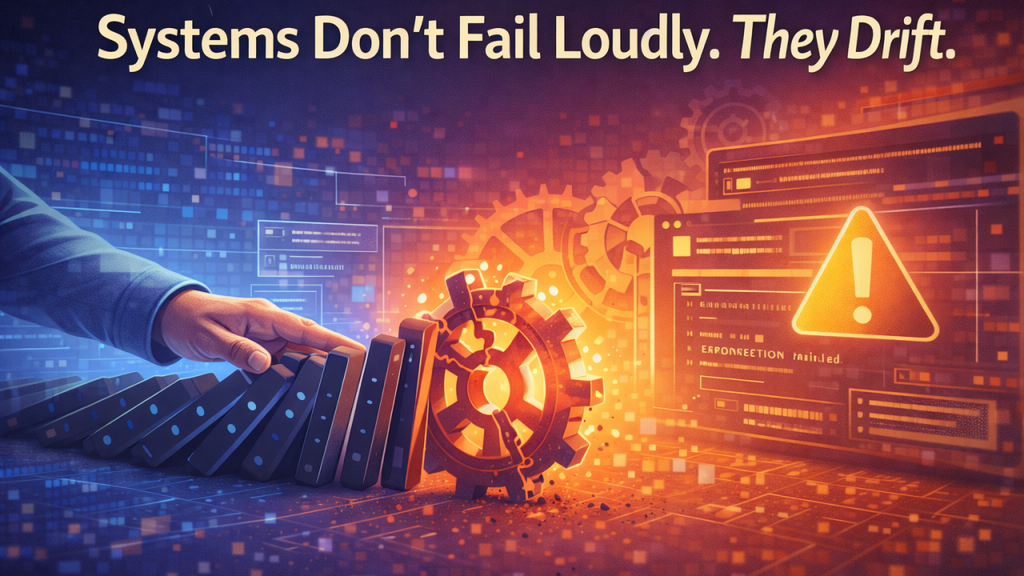
Most people assume that once a piece of software is built and launched, it simply keeps running the way it did on day one. The interface looks the same, the buttons still work, and nothing seems to have changed, so the natural conclusion is that the underlying system is stable and finished. This belief treats software like a physical object rather than a living process, something that gets completed rather than something that keeps evolving after release.
The reality is far less tidy. Every application sits inside a shifting environment made up of operating system updates, browser changes, third-party integrations, and security patches that arrive on someone else’s schedule, not the company’s. A payment processor updates its API, a hosting provider changes its default configuration, or a browser stops supporting an older type of code, and suddenly a system that worked perfectly last month starts behaving strangely. None of this shows up as an obvious crash right away. It shows up as small glitches, slower load times, or features that quietly stop functioning for a subset of users, long before anyone notices a real problem.
What the Research Shows
Studies of software lifecycle costs consistently point to the same uncomfortable fact: building a system is only a fraction of the total investment. Industry estimates suggest that ongoing upkeep, bug fixes, security patching, and compatibility adjustments account for the majority of a system’s lifetime cost, often outweighing the original development budget within a few years. Organizations that treat launch day as the finish line tend to underestimate how much attention a system needs afterward, and that gap becomes expensive fast.
Companies that build ongoing upkeep into their planning from the start tend to avoid the worst of these surprises, which is why many organizations turn to dedicated software maintenance services rather than trying to handle every patch and update internally. Outsourcing this work does not mean handing over control; it means having a team whose job is specifically to watch for the small warning signs that internal staff, focused on new features, are likely to miss. The pattern shows up across industries, from healthcare scheduling platforms to retail inventory systems, where the cost of a missed update is rarely a single dramatic failure but a slow accumulation of friction that eventually drives users away.
Public health data offers an unexpected but useful parallel here. Just as preventive checkups catch small issues before they become serious medical problems, regular software checkups catch small technical issues before they cascade into outages. The CDC’s own approach to prevention, outlined in its CDC health and wellness resources, emphasizes that consistent, low-cost monitoring produces better long-term outcomes than reactive treatment after a crisis has already developed. The same logic applies directly to digital infrastructure, where waiting for a visible failure is almost always more expensive than steady, planned attention.
Practical Takeaways
Teams that want to avoid the slow decay described above tend to build a few habits into their routine. They schedule regular reviews of dependencies and third-party integrations instead of waiting for something to break. They track performance metrics over time so a gradual slowdown gets flagged before users start complaining, and they keep documentation current so that whoever handles a fix six months from now understands what they are looking at.
None of this requires a massive overhaul or a dramatic shift in strategy. Small, consistent effort applied on a regular schedule produces far better outcomes than sporadic, panicked fixes applied only after a visible failure has already frustrated customers or exposed a security gap. A quarterly review of system health, paired with a clear process for applying patches promptly, catches most problems while they are still small and inexpensive to fix.
The organizations that get this right rarely talk about it publicly, because their systems simply keep working without drawing attention. Their customers never experience the outage, the slow page load, or the security scare that shows up in headlines elsewhere. Quiet reliability is the actual goal of good maintenance practice, and it comes from treating software as an ongoing responsibility rather than a finished product sitting on a shelf.
