
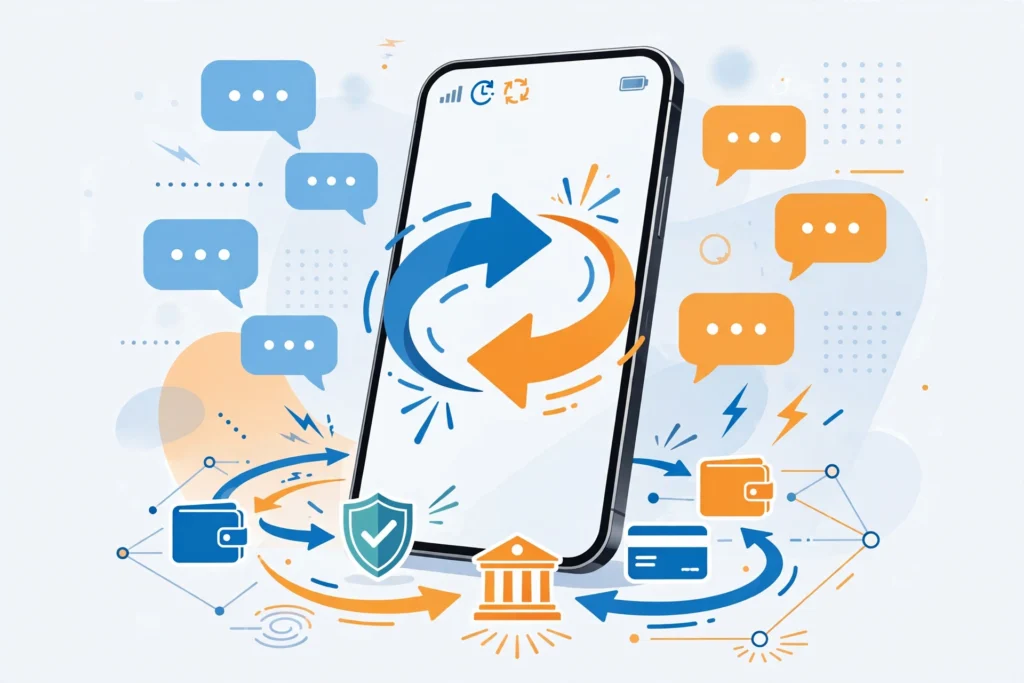
Sending a message takes a second, costs almost nothing and works at any hour. Sending money, by contrast, has long meant cut-off times, business days and a nervous wait for funds to clear. A lively discussion on r/finance asked a simple question that is now shaping policy and banking strategy around the world: in the future, will money move as fast as sending a message?
In a growing number of countries, the answer is already yes. Real-time payment rails settle transfers in seconds, twenty-four hours a day, including weekends and holidays. The sender taps confirm, the recipient sees the money almost immediately, and neither side has to wonder where the payment is sitting overnight.
The Rails Behind Instant Money
The United States entered this era at national scale with FedNow, the Federal Reserve’s instant payment service launched in 2023. As the Federal Reserve explains, FedNow allows banks and credit unions to offer instant payments around the clock, with funds available to recipients within seconds. It sits alongside the private RTP network, which has operated in the United States since 2017.
India’s Unified Payments Interface, known as UPI, shows what happens when instant payments become an everyday habit. UPI lets people pay merchants, friends and family directly from bank accounts using a phone, and it now processes billions of transactions every month. Brazil’s Pix, the euro area’s SEPA Instant Credit Transfer and Britain’s Faster Payments tell a similar story: once transfers become instant and cheap, people quickly stop accepting delays.
For background on business and technology trends, readers can visit Upload Insider.
Why Speed Changes More Than Convenience
Instant settlement changes behaviour, not just timing. A small business paid immediately does not need to borrow while waiting for card receipts to clear. A worker paid at the end of a shift can use the money the same evening. A family receiving support from abroad, or from across the country, can rely on it arriving when it is needed most, rather than after a weekend has passed.
Payment behaviour on phones is already shifting, as recent coverage of avoiding transaction surprises with smartphone payments shows. It also changes expectations. People who can move money instantly between their own accounts are less tolerant of slow refunds, delayed wages and unclear payment statuses. Banks and payment apps are responding by making instant transfers a standard feature rather than a premium extra, and by building services such as request-to-pay and instant bill settlement on top of the new rails.
The Obstacles That Remain
Speed brings its own risks. A payment that settles in seconds is also hard to reverse, which makes fraud and mistaken transfers more serious. If a scammer persuades someone to send money instantly, there may be no cooling-off window in which a bank can intervene. Providers have answered with confirmation-of-payee checks, warnings for new recipients and limits for first-time transfers, but the balance between speed and safety remains delicate.
Adoption is uneven, too. Not every bank offers instant payments yet, fees and limits vary, and sending money across borders is still far slower and more expensive than sending it within one country. Projects linking national fast-payment systems, and experiments by central banks with faster cross-border settlement, aim to close that gap, but a truly global instant network is still some years away.
Interoperability matters as well. A message can travel between any two apps and networks without the sender thinking about it. Money will feel truly message-like only when any account can pay any other account, on any platform, with the same ease.
So, Will Money Move Like a Message?
Technically, in many places it already does. The remaining work is about reach, trust and habit: connecting every bank, protecting users without slowing them down, and extending instant settlement across borders. Industry reporting on payment modernisation, including coverage by FRB Services on the FedNow Service, points in one direction: participation keeps growing and volumes keep rising.
The likely future is not that money becomes exactly like a text. Payments carry identity checks, fraud controls and legal obligations that messages do not. But from the user’s side of the screen, the experience is converging fast. Typing an amount, tapping send and seeing the money arrive before the conversation has moved on will soon feel ordinary, and the old question of why a transfer takes three business days will be the one that sounds strange.
