
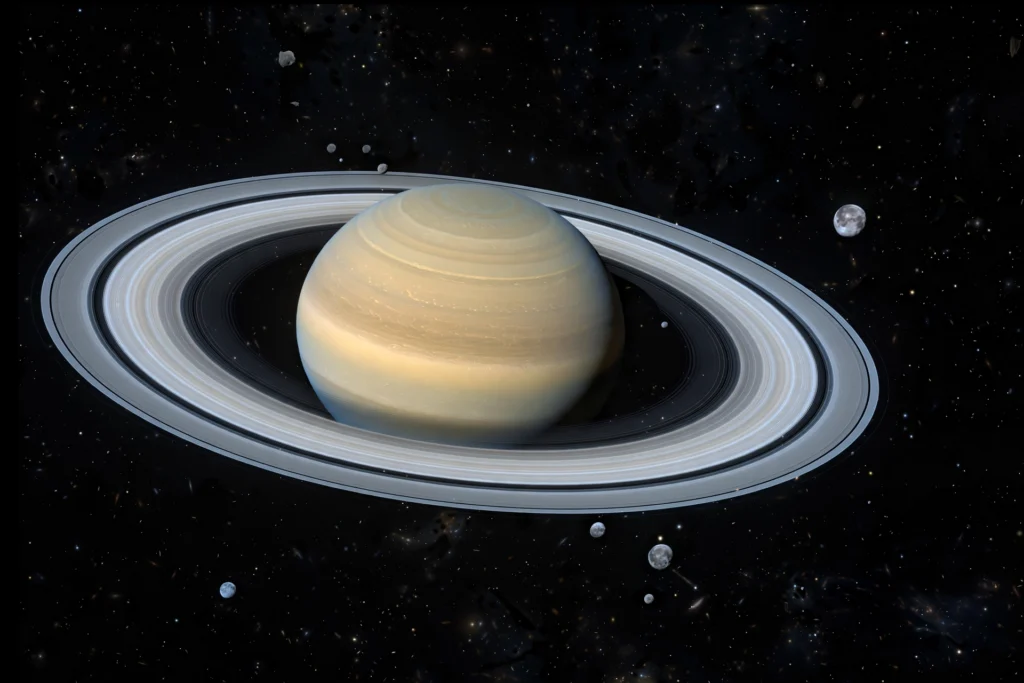
Think of the discovery as a file that took years to upload. Astronomers have confirmed 128 new moons of Saturn, taking the planet’s total to 274, more than every other planet combined. None of these moons announced itself in a single dramatic image. Each one emerged gradually, as deep exposures collected over several years were processed until a faint moving point could no longer be doubted. For a site that spends its time inside digital workflows, including our coverage of instant payments and data moving at message speed, this is data moving at the opposite tempo, and arriving all the more convincingly for it.
Confirmed means confirmed
The new moons have been recognised by the International Astronomical Union, lifting Saturn from its previous count of 146. Recognition follows a strict standard: an object must be observed often enough, over a long enough span, for its orbit around Saturn to be secure. Anything less stays a candidate. That discipline is why the total can jump by 128 at once. The sky did not change suddenly; the evidence files on dozens of faint objects finally crossed the threshold from probable to proven, one checked orbit at a time.
The observatory behind the data
The images came from the Canada-France-Hawaii Telescope on Mauna Kea in Hawaii, an instrument whose capabilities are set out by the CFHT observatory. The research team included astronomers from the University of British Columbia, among them Dr Edward Ashton, a specialist in the small outer moons of the giant planets. Their survey returned to Saturn’s surroundings season after season, because orbits are not read from snapshots. They are assembled from repeated measurements, each new image confirming or correcting where a tiny moon was expected to be.
Shift and stack, the insider method
The processing step that made this possible is called shift and stack. Software shifts each exposure to follow the motion a Saturn moon should have, then stacks the aligned frames. A real moon reinforces, growing from invisibility into a reliable detection, while background stars stretch into trails and random noise washes out. Run the process at slightly different rates and directions, and you can hunt for moons on different kinds of orbits. It is an elegant reminder that in modern astronomy, the archive and the algorithm are instruments in their own right.
Meet the irregulars
The moons recovered this way share a profile. They are irregular: small bodies, typically a few kilometres across, orbiting far from Saturn on tilted paths. Many are retrograde, travelling against the planet’s rotation. That profile is the signature of capture rather than local formation. Instead of condensing from the disc that built Saturn and its great inner moons, these objects most likely formed elsewhere in the early solar system, drifted within reach, and were caught by the giant planet’s gravity, where they have remained as distant, eccentric companions ever since.
Families of fragments
A closer look at the orbits reveals clusters, moons travelling in families with related paths. The explanation favoured by researchers is collisional break-up: a larger captured moon was struck and shattered, and its fragments continued on similar orbits. Over immense time, the family spreads but does not fully disperse. This is why Saturn’s count is so extreme. The planet did not need to capture 274 separate wanderers. It captured larger bodies and inherited their debris, and every fragment large enough to track now contributes its own line to a total that keeps humbling the other planets.
Why insiders should care about slow science
There is a lesson in this discovery for anyone who works with information. The moons were always there; what changed was the quality of the evidence and the patience to process it properly. Saturn’s 274 moons set a benchmark other planets’ surveys will chase, and the methods refined here, deep archives, motion-matched stacking, disciplined follow-up, are exactly the methods that will chase them. The upload, in other words, is still in progress. More faint companions are almost certainly waiting in data already collected, and Saturn’s extraordinary total may yet climb higher.
