
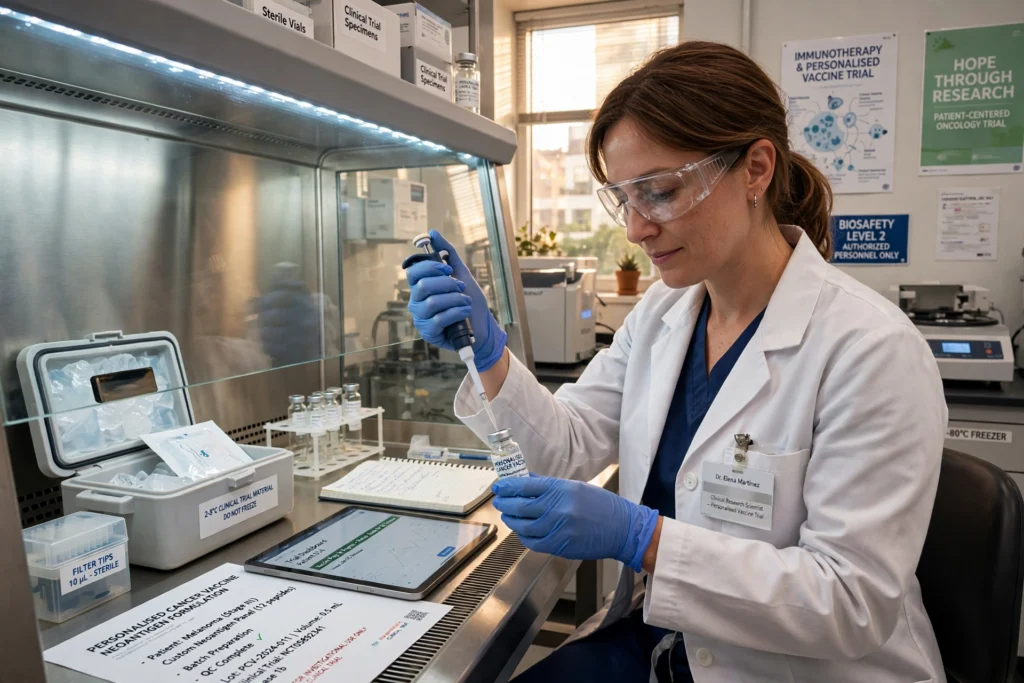
Here is the whole file, caveats included, because with early cancer research the caveats are part of the news. NeoVax, a personalised neoantigen vaccine made from each patient’s own tumour mutations, has been tested with nivolumab in a phase 1 trial in platinum-sensitive recurrent ovarian cancer, published in Nature Medicine. The trial found that the vaccines could be manufactured and administered, that safety was acceptable, and that immune responses were seen. It did not find that the treatment cures cancer or extends life, because a trial of this size and stage cannot do that. Health readers can compare our approach in our evidence-first health guides.
What makes NeoVax personal
A tumour accumulates mutations, and some create neoantigens, abnormal fragments that mark cancer cells as different from healthy ones. NeoVax is built by identifying such targets in one patient’s tumour and manufacturing a vaccine intended to train that patient’s immune system against them. The National Cancer Institute provides background on neoantigen approaches and why they attract researchers: in principle, the immune attack can be specific to the cancer. In practice, specificity means bespoke production, and bespoke production means the first question is whether it can be done at all, reliably, for people who are actually ill.
The role of nivolumab
Nivolumab, the vaccine’s partner in this trial, is a PD-1 immune checkpoint inhibitor. It blocks a signal that tumours use to restrain T cells, aiming to keep an immune response active once it starts. The pairing is deliberate. NeoVax attempts to aim the immune system at tumour-specific targets; nivolumab attempts to stop that aimed response being throttled. Understanding the combination helps explain the trial’s immune measurements: researchers were watching whether T cells responded to the vaccine’s targets, in a regimen designed to give those T cells their best chance of staying switched on.
Feasibility and safety: the actual endpoints
Phase 1 trials exist to answer practical and safety questions before anything else. The report in Nature Medicine addresses whether personalised vaccines could be produced and given to women with recurrent ovarian cancer whose disease remained platinum-sensitive, and whether the combined regimen’s side effects were acceptable in that context. Those answers were affirmative, within the limits of an early study. For a therapy whose supply chain begins inside each patient’s tumour, demonstrating that the whole sequence can be completed in a clinical trial is a result worth reporting accurately.
The immune signal
Beyond delivery, the team observed immune responses, including T-cell responses linked to the targeted neoantigens. That signal tells researchers the personalised design can engage the immune system as intended, rather than disappearing without effect. It also provides material for the next round of questions: which targets provoke the strongest responses, how durable those responses are, and whether they can be connected to clinical outcomes in future work. A signal is not an outcome, and the distance between the two is where most early therapies either advance or quietly stop.
Strictly no cure claims
To be explicit, because this is where coverage usually fails: this trial provides no basis for claiming efficacy. It was small, early, and not designed to measure whether NeoVax improves survival or controls disease. Anyone who has faced recurrent ovarian cancer, or watched someone face it, deserves reporting that keeps hope and evidence in their proper places. The researchers’ own framing is feasibility and safety. Acceptable safety plus immune responses is a green light for further study. It is not a verdict on whether the vaccine helps patients, and presenting it as one would be a disservice.
What happens after the upload
The next files in this story should be larger trials with comparison groups, prespecified clinical endpoints, and longer follow-up, alongside faster and more scalable personalised manufacturing. If those studies show that immune responses translate into real benefit, NeoVax-style vaccines could earn a place in ovarian cancer care. If they do not, the field will still have learned how to build and test bespoke vaccines safely, knowledge that transfers to other cancers. For now, the accurate summary fits in one line: feasible to make, feasible to give, acceptably safe, immunologically active, and unproven where it matters most, pending larger studies.
